How to use this calculator
Evaluate populations indirectly through energy, entropy and heat capacity for a finite set of thermally accessible quantum energy levels.
- Enter Molar energy levels (kJ/mol), Degeneracy of each energy level, Equilibrium temperature (K). Match the units shown beside each field and review the result together with the assumptions below.
- Read the worked example below to check the expected input format and result.
- Compare another scenario by changing one input at a time. Use Reset to return to the starting values.
Canonical discrete energy levels thermal properties explained
A numerical walkthrough
Molar energy levels (kJ/mol) = [0, 2, 5]; Degeneracy of each energy level = [1, 3, 2]; Equilibrium temperature (K) = 300.
- Mean molar energy: 1.544294 kJ/mol
- Molar state entropy: 13.139996 J/mol/K
- Molar heat capacity from these levels: 3.005906 J/mol/K
Levels at 0, 2 and 5 kJ/mol with degeneracies 1, 3 and 2 at 300 K give mean energy 1.54429 kJ/mol, state entropy 13.1400 J/mol/K and a 3.00591 J/mol/K heat-capacity contribution. More populated states need not have the lowest raw energy when degeneracy differs.
The model behind the numbers
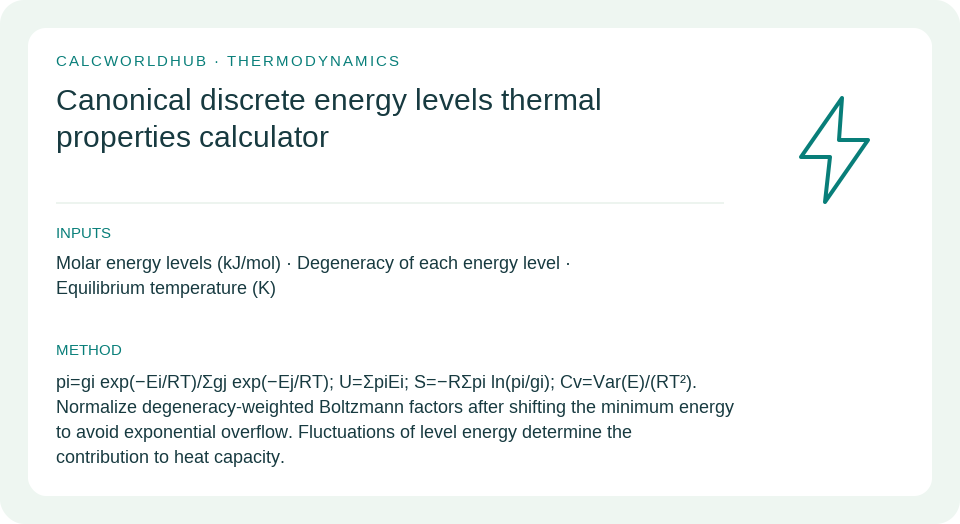
pi=gi exp(−Ei/RT)/Σgj exp(−Ej/RT); U=ΣpiEi; S=−RΣpi ln(pi/gi); Cv=Var(E)/(RT²).
Normalize degeneracy-weighted Boltzmann factors after shifting the minimum energy to avoid exponential overflow. Fluctuations of level energy determine the contribution to heat capacity.
What to enter
E— Molar energy levels (kJ/mol)- List distinct state energies on one common zero reference, one entry per energy level. Use comma-separated values in the stated order.
g— Degeneracy of each energy level- Positive number of distinct quantum states sharing each listed energy; list length must match the energy levels. Use comma-separated values in the stated order.
T— Equilibrium temperature (K)- Equilibrium temperature (K). Enter the value for this state; the units shown are used without an unstated conversion.
Interpreting the result
Noninteracting distinguishable particles in thermal equilibrium with fixed energy levels. Translational, rotational or other omitted modes are not silently included.
Reading the outputs
Mean energy follows the entered kJ/mol reference; state entropy and heat capacity use J/mol/K.
Frequently asked questions
Why does degeneracy affect entropy?
More distinct microstates can share the same energy; their multiplicity contributes even when the energy is unchanged.
Can I shift all energy levels by a constant?
Yes. Mean energy shifts by that constant, while populations, heat capacity and entropy stay unchanged.
Is this the Debye model?
No. It treats a finite explicitly listed level spectrum rather than collective crystal vibration modes.
How do I use the Canonical discrete energy levels thermal properties calculator?
Enter Molar energy levels (kJ/mol), Degeneracy of each energy level, Equilibrium temperature (K). Match the units shown beside each field and review the result together with the assumptions below.
What is a worked example of Canonical discrete energy levels thermal properties?
Molar energy levels (kJ/mol) = [0, 2, 5]; Degeneracy of each energy level = [1, 3, 2]; Equilibrium temperature (K) = 300. Mean molar energy: 1.544294 kJ/mol Molar state entropy: 13.139996 J/mol/K Molar heat capacity from these levels: 3.005906 J/mol/K Levels at 0, 2 and 5 kJ/mol with degeneracies 1, 3 and 2 at 300 K give mean energy 1.54429 kJ/mol, state entropy 13.1400 J/mol/K and a 3.00591 J/mol/K heat-capacity contribution. More populated states need not have the lowest raw energy when degeneracy differs.
Background or definition reference: MIT statistical thermodynamics: Boltzmann factors and partition functions.
Read our calculation methodology.