How to use this calculator
Estimate a crystal’s lattice heat capacity from the collective acoustic-vibration Debye model, including low-temperature suppression.
- Enter Solid temperature (K), Debye temperature (K), Atoms per chemical formula unit. Match the units shown beside each field and review the result together with the assumptions below.
- Read the worked example below to check the expected input format and result.
- Compare another scenario by changing one input at a time. Use Reset to return to the starting values.
Debye lattice heat capacity across temperature explained
Integrate the Debye phonon spectrum to estimate lattice heat capacity relative to its classical high-temperature limit.
How the calculation works
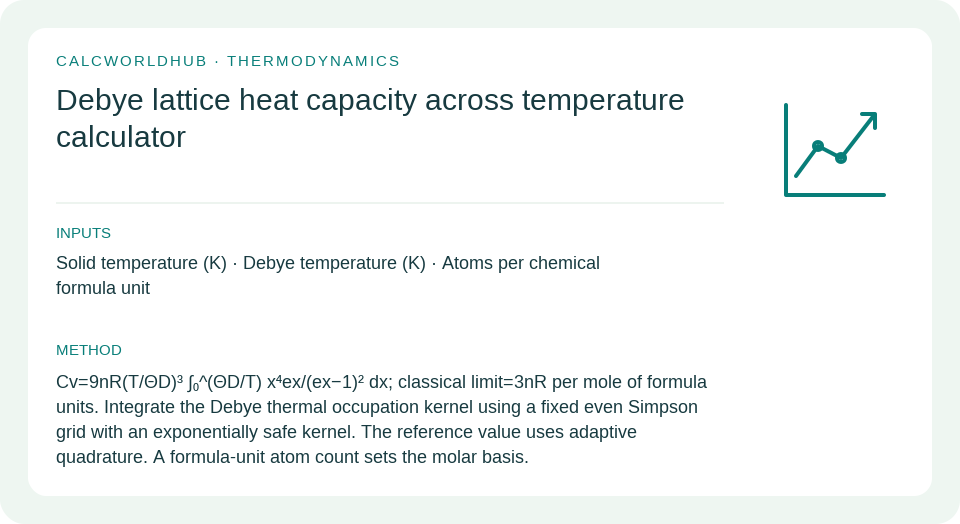
Cv=9nR(T/ΘD)³ ∫₀^(ΘD/T) x⁴ex/(ex−1)² dx; classical limit=3nR per mole of formula units.
Integrate the Debye thermal occupation kernel using a fixed even Simpson grid with an exponentially safe kernel. The reference value uses adaptive quadrature. A formula-unit atom count sets the molar basis.
Set up the calculation
T— Solid temperature (K)- Absolute sample temperature in kelvin; zero is outside this integral form because the upper integration limit divides by T.
theta— Debye temperature (K)- Material-specific characteristic cutoff temperature ΘD that sets the phonon frequency range in the Debye model.
n— Atoms per chemical formula unit- Number n of atoms in one formula unit; it scales the classical molar limit to 3nR per mole of formula units.
Limits of this model
Ideal Debye spectrum, no electronic, magnetic, optical-branch or phase-transition contribution. Extremely low T/Θ may require tighter numerical resolution; this is a model curve, not a substitute for measured material data.
Check this example
Solid temperature (K) = 100; Debye temperature (K) = 400; Atoms per chemical formula unit = 1.
- Lattice molar heat capacity: 12.548004 J/mol formula/K
- Classical high-temperature limit: 24.943388 J/mol formula/K
- Fraction of classical limit: 50.305933 %
A one-atom formula unit with Debye temperature 400 K at 100 K has predicted lattice heat capacity 12.5480 J/mol/K. That is 50.3059% of its 24.9434 J/mol/K classical high-temperature limit, illustrating partial vibrational excitation.
Reading the outputs
Returns lattice Cv per mole of formula units, its classical 3nR limit and the percent of that limit.
Frequently asked questions
Is this total measured heat capacity?
No. Metals can have an additional electronic contribution and magnetic or structural effects can be important.
Why enter atoms per formula unit?
One mole of a compound contains n moles of atoms, so its classical molar limit is 3nR.
What should happen at high temperature?
The lattice heat capacity approaches the classical limit, while at low temperature it approaches a T³ law.
How do I use the Debye lattice heat capacity across temperature calculator?
Enter Solid temperature (K), Debye temperature (K), Atoms per chemical formula unit. Match the units shown beside each field and review the result together with the assumptions below.
What is a worked example of Debye lattice heat capacity across temperature?
Solid temperature (K) = 100; Debye temperature (K) = 400; Atoms per chemical formula unit = 1. Lattice molar heat capacity: 12.548004 J/mol formula/K Classical high-temperature limit: 24.943388 J/mol formula/K Fraction of classical limit: 50.305933 % A one-atom formula unit with Debye temperature 400 K at 100 K has predicted lattice heat capacity 12.5480 J/mol/K. That is 50.3059% of its 24.9434 J/mol/K classical high-temperature limit, illustrating partial vibrational excitation.
Background or definition reference: MIT physical chemistry: Einstein and Debye solids.
Read our calculation methodology.