How to use this calculator
Relate a material’s measured thermal expansion and compressibility to the difference between constant-pressure and constant-volume heat capacity.
- Enter Absolute material temperature (K), Molar volume (m³/mol), Volumetric thermal expansivity (1/K), Isothermal compressibility (1/Pa), then complete the remaining labeled fields. Match the units shown beside each field and review the result together with the assumptions below.
- Read the worked example below to check the expected input format and result.
- Compare another scenario by changing one input at a time. Use Reset to return to the starting values.
Heat-capacity difference from thermal response properties explained
The identity estimates the Cp−Cv difference from the entered thermodynamic response properties at the specified state; consistent molar units are required.
Inputs, symbols, and units
T— Absolute material temperature (K)- Absolute material temperature (K). Enter the value for this state; the units shown are used without an unstated conversion.
v— Molar volume (m³/mol)- Molar volume (m³/mol). Enter the value for this state; the units shown are used without an unstated conversion.
beta— Volumetric thermal expansivity (1/K)- Volumetric thermal expansivity (1/K). Enter the value for this state; the units shown are used without an unstated conversion.
kappa— Isothermal compressibility (1/Pa)- Isothermal compressibility (1/Pa). Enter the value for this state; the units shown are used without an unstated conversion.
cv— Molar constant-volume heat capacity (J/mol/K)- Molar constant-volume heat capacity (J/mol/K). Enter the value for this state; the units shown are used without an unstated conversion.
Formula and method
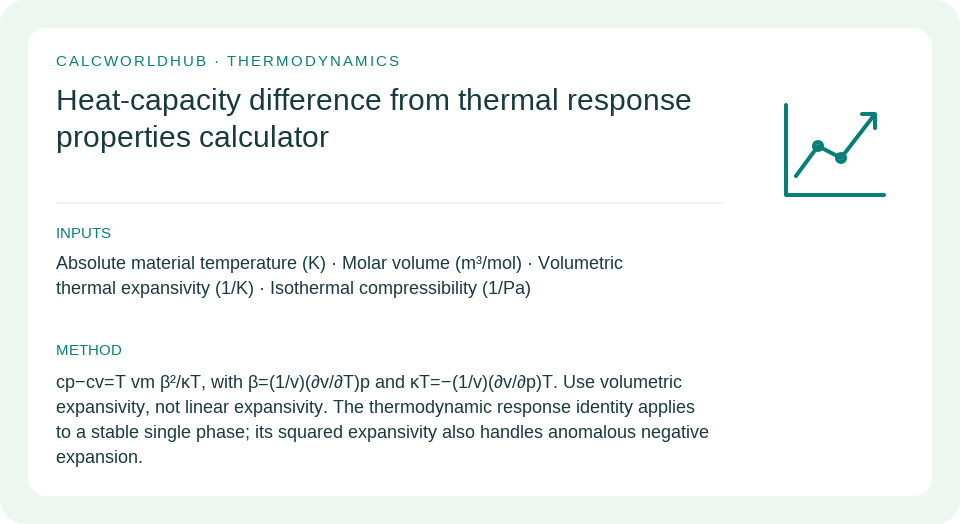
cp−cv=T vm β²/κT, with β=(1/v)(∂v/∂T)p and κT=−(1/v)(∂v/∂p)T.
Use volumetric expansivity, not linear expansivity. The thermodynamic response identity applies to a stable single phase; its squared expansivity also handles anomalous negative expansion.
A worked scenario
Absolute material temperature (K) = 300; Molar volume (m³/mol) = 0.000018; Volumetric thermal expansivity (1/K) = 0.00021; Isothermal compressibility (1/Pa) = 4.60000000e-10; Molar constant-volume heat capacity (J/mol/K) = 74.
- Molar constant-pressure heat capacity: 74.517696 J/mol/K
- cp minus cv: 0.517696 J/mol/K
- Heat-capacity ratio: 1.006996
At 300 K, molar volume 18e−6 m³/mol, expansivity 0.00021/K and compressibility 4.6e−10/Pa imply cp−cv=0.517696 J/mol/K. Supplying cv=74 gives cp=74.5177 J/mol/K; the difference is not universally the ideal-gas constant.
Assumptions and edge cases
Single equilibrium phase and mutually consistent local response data. Near critical points or phase transitions, simple finite input values may not adequately resolve divergent response functions.
Reading the outputs
Molar cp and cp−cv use J/mol/K; their ratio to supplied cv is dimensionless.
Frequently asked questions
Can I use a linear expansion coefficient?
For an isotropic solid and small strain, volumetric beta is approximately three times the linear coefficient; use verified data for anisotropic materials.
What happens when expansivity is negative?
The heat-capacity difference stays nonnegative because expansivity is squared.
Does cp−cv always equal R?
Only for an ideal gas. This general identity also describes liquids and solids.
How do I use the Heat-capacity difference from thermal response properties calculator?
Enter Absolute material temperature (K), Molar volume (m³/mol), Volumetric thermal expansivity (1/K), Isothermal compressibility (1/Pa), then complete the remaining labeled fields. Match the units shown beside each field and review the result together with the assumptions below.
What is a worked example of Heat-capacity difference from thermal response properties?
Absolute material temperature (K) = 300; Molar volume (m³/mol) = 0.000018; Volumetric thermal expansivity (1/K) = 0.00021; Isothermal compressibility (1/Pa) = 4.60000000e-10; Molar constant-volume heat capacity (J/mol/K) = 74. Molar constant-pressure heat capacity: 74.517696 J/mol/K cp minus cv: 0.517696 J/mol/K Heat-capacity ratio: 1.006996 At 300 K, molar volume 18e−6 m³/mol, expansivity 0.00021/K and compressibility 4.6e−10/Pa imply cp−cv=0.517696 J/mol/K. Supplying cv=74 gives cp=74.5177 J/mol/K; the difference is not universally the ideal-gas constant.
Read our calculation methodology.