How to use this calculator
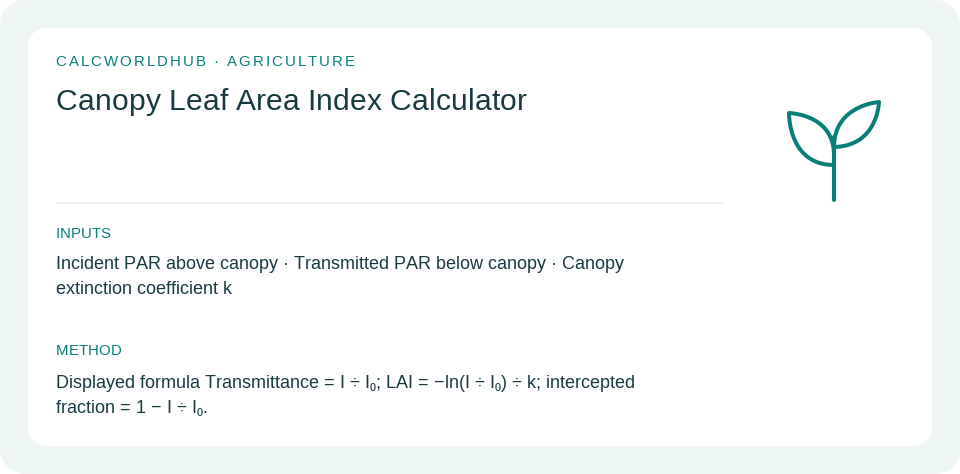
Estimate canopy leaf area index from above- and below-canopy photosynthetically active radiation.
- Enter Incident PAR above canopy, Transmitted PAR below canopy, Canopy extinction coefficient k. Match the units shown beside each field and review the result together with the assumptions below.
- Read the worked example below to check the expected input format and result.
- Compare another scenario by changing one input at a time. Use Reset to return to the starting values.
How this calculation works
Canopy transmittance is below-canopy photosynthetically active radiation divided by the above-canopy reading. Under the Beer–Lambert canopy model, this transmittance decreases exponentially with leaf area index and the canopy extinction coefficient.
Inputs and units
incidentPar— Incident PAR above canopy- Above-canopy photosynthetically active radiation in the measurement unit.
transmittedPar— Transmitted PAR below canopy- Below-canopy photosynthetically active radiation in the same unit; must be greater than zero and no higher than incident PAR.
extinctionCoefficient— Canopy extinction coefficient k- Positive dimensionless coefficient for the canopy and measurement geometry.
Formula
Transmittance = I ÷ I₀; LAI = −ln(I ÷ I₀) ÷ k; intercepted fraction = 1 − I ÷ I₀.
Method
Enter incident PAR above the canopy, transmitted PAR below it, and a positive extinction coefficient appropriate to the canopy and measurement setup. The PAR readings must use the same units and sampling basis.
Worked example
Above-canopy PAR of 1,000 and below-canopy PAR of 300 give transmittance 0.30. With k = 0.50, LAI = −ln(0.30) ÷ 0.50 = 2.408, and the intercepted PAR fraction is 70%.
Assumptions and limits
This is a Beer–Lambert estimate. The extinction coefficient depends on canopy architecture, leaf angle, species, and measurement geometry. Sun angle, clumping, soil background, sensor alignment, and spatial sampling can affect inferred LAI; this result is not a direct leaf-area measurement.
Frequently asked questions
What is the incident PAR reading?
It is the photosynthetically active radiation measured above the canopy for the same sampling interval as the below-canopy reading.
Can I use any extinction coefficient?
Use a coefficient appropriate to the canopy structure, leaf angle, and measurement geometry; the estimate changes directly with that choice.
Is this a direct measurement of leaf area?
No. It infers LAI from light attenuation under the stated exponential canopy model.
How do I use the Canopy Leaf Area Index Calculator?
Enter Incident PAR above canopy, Transmitted PAR below canopy, Canopy extinction coefficient k. Match the units shown beside each field and review the result together with the assumptions below.
What is a worked example of Canopy Leaf Area Index?
Above-canopy PAR of 1,000 and below-canopy PAR of 300 give transmittance 0.30. With k = 0.50, LAI = −ln(0.30) ÷ 0.50 = 2.408, and the intercepted PAR fraction is 70%.
Reference: FAO explanation of the exponential canopy transmittance relationship, LAI, and extinction coefficient. See our calculation methodology.