How to use this calculator
Refer the nonlinear limits of successive RF stages back to the receiver input before selecting a gain distribution.
- Enter Stage power gains (dB), Stage input IP3 values (dBm). Match the units shown beside each field and review the result together with the assumptions below.
- Read the worked example below to check the expected input format and result.
- Compare another scenario by changing one input at a time. Use Reset to return to the starting values.
Cascaded receiver input intercept point explained
For a cascade of weakly nonlinear receiver stages, input-referred third-order intercept contributions add after each preceding stage’s gain is applied in linear power. The result is an approximate cascade IIP3 and corresponding OIP3, assuming the listed stage order and the usual uncorrelated cubic-distortion convention.
How the calculation works
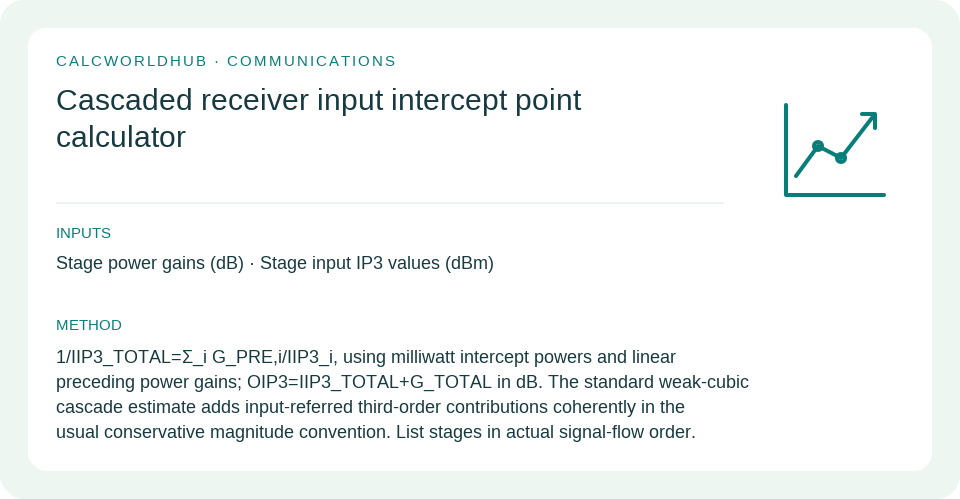
1/IIP3_TOTAL=Σ_i G_PRE,i/IIP3_i, using milliwatt intercept powers and linear preceding power gains; OIP3=IIP3_TOTAL+G_TOTAL in dB.
The standard weak-cubic cascade estimate adds input-referred third-order contributions coherently in the usual conservative magnitude convention. List stages in actual signal-flow order.
Set up the calculation
gain— Stage power gains (dB)- Ordered available power gains; a lossy stage has negative gain. Use comma-separated values in the stated order.
iip3— Stage input IP3 values (dBm)- Input-referred third-order intercept at each stage own input. Use comma-separated values in the stated order.
Limits of this model
Small-signal scalar approximation with matched stages and no cancellation. Compression, frequency-selective blockers and inter-stage phase can change actual distortion.
Check this example
Stage power gains (dB) = 15,-6,20; Stage input IP3 values (dBm) = 5,20,15.
- Cascade input IP3: 0.537226 dBm
- Cascade output IP3: 29.537226 dBm
- Net power gain: 29 dB
A 15 dB front end, 6 dB conversion loss and 20 dB IF stage are entered separately; a downstream stage can limit input linearity after preceding gain.
Reading the outputs
Input and output intercepts are extrapolated dBm values. Net gain is the sum of stage dB gains, and is not a measured compression point.
Frequently asked questions
Is IP3 an allowable input power?
No; it is the intersection of extrapolated linear and cubic trends, often beyond compression.
Can a passive attenuator appear?
Use its negative gain and a suitably high measured intercept; gain reduction alone is not a substitute for its nonlinear specification.
Why can the last stage dominate?
Earlier gain raises the blocker power seen by that stage, magnifying its input-referred contribution.
How do I use the Cascaded receiver input intercept point calculator?
Enter Stage power gains (dB), Stage input IP3 values (dBm). Match the units shown beside each field and review the result together with the assumptions below.
What is a worked example of Cascaded receiver input intercept point?
Stage power gains (dB) = 15,-6,20; Stage input IP3 values (dBm) = 5,20,15. Cascade input IP3: 0.537226 dBm Cascade output IP3: 29.537226 dBm Net power gain: 29 dB A 15 dB front end, 6 dB conversion loss and 20 dB IF stage are entered separately; a downstream stage can limit input linearity after preceding gain.
Background or definition reference: Analog Devices cascaded intercept analysis.
Read our calculation methodology.