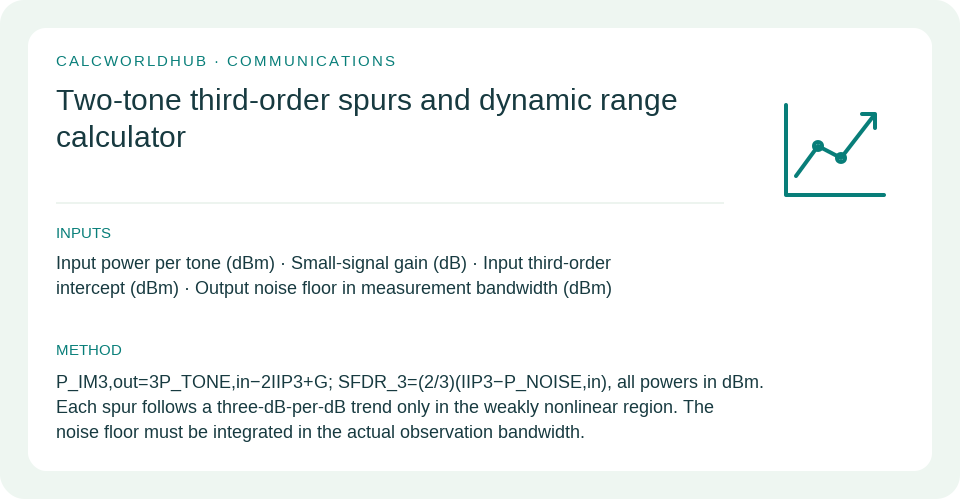
How to use this calculator
Predict the in-band 2f1−f2 and 2f2−f1 products of an equal-power two-tone test and the associated noise-limited dynamic range.
- Enter Input power per tone (dBm), Small-signal gain (dB), Input third-order intercept (dBm), Output noise floor in measurement bandwidth (dBm). Match the units shown beside each field and review the result together with the assumptions below.
- Read the worked example below to check the expected input format and result.
- Compare another scenario by changing one input at a time. Use Reset to return to the starting values.
Two-tone third-order spurs and dynamic range explained
A numerical walkthrough
Input power per tone (dBm) = -25; Small-signal gain (dB) = 15; Input third-order intercept (dBm) = 5; Output noise floor in measurement bandwidth (dBm) = -100.
- Third-order output spur per product: -70 dBm
- Fundamental output per tone: -10 dBm
- Third-order spurious-free dynamic range: 80 dB
Two −25 dBm input tones in a 15 dB gain stage with +5 dBm IIP3 create much smaller third-order products than the −10 dBm fundamentals.
The model behind the numbers
P_IM3,out=3P_TONE,in−2IIP3+G; SFDR_3=(2/3)(IIP3−P_NOISE,in), all powers in dBm.
Each spur follows a three-dB-per-dB trend only in the weakly nonlinear region. The noise floor must be integrated in the actual observation bandwidth.
What to enter
pin— Input power per tone (dBm)- Equal power of each of two test tones, before the device.
gain— Small-signal gain (dB)- Power gain in the tested band.
iip3— Input third-order intercept (dBm)- Measured or specified input-referred IP3.
floor— Output noise floor in measurement bandwidth (dBm)- Integrated output noise floor in the same bandwidth as a spur measurement.
Interpreting the result
Equal tones, weak third-order distortion and flat gain. Unequal blockers, second-order products and saturation require a richer model.
Reading the outputs
Spur and fundamental powers refer to individual products or tones. SFDR is a bandwidth-specific dynamic range, not a dBm level.
Frequently asked questions
Should I enter the combined two-tone power?
No; enter the power of one tone. The combined average is about 3 dB higher for equal tones.
Does reducing bandwidth improve SFDR?
It lowers integrated white noise and therefore changes the reported noise-limited dynamic range.
Does a higher IP3 guarantee no compression?
No; use the device compression specification independently.
How do I use the Two-tone third-order spurs and dynamic range calculator?
Enter Input power per tone (dBm), Small-signal gain (dB), Input third-order intercept (dBm), Output noise floor in measurement bandwidth (dBm). Match the units shown beside each field and review the result together with the assumptions below.
What is a worked example of Two-tone third-order spurs and dynamic range?
Input power per tone (dBm) = -25; Small-signal gain (dB) = 15; Input third-order intercept (dBm) = 5; Output noise floor in measurement bandwidth (dBm) = -100. Third-order output spur per product: -70 dBm Fundamental output per tone: -10 dBm Third-order spurious-free dynamic range: 80 dB Two −25 dBm input tones in a 15 dB gain stage with +5 dBm IIP3 create much smaller third-order products than the −10 dBm fundamentals.
Background or definition reference: Analog Devices cascaded intercept analysis.
Read our calculation methodology.