How to use this calculator
Combine source, sky, dark-current shot noise, and one read into an aperture-photometry SNR estimate.
- Enter Source electrons per second, Sky electrons per pixel per second, Dark electrons per pixel per second, Aperture pixels, then complete the remaining labeled fields. Match the units shown beside each field and review the result together with the assumptions below.
- Read the worked example below to check the expected input format and result.
- Compare another scenario by changing one input at a time. Use Reset to return to the starting values.
CCD aperture photometry signal to noise explained
This exposure separates source shot noise, aperture background counts, and per-pixel read-noise variance.
A numerical walkthrough
Source electrons per second = 100; Sky electrons per pixel per second = 2; Dark electrons per pixel per second = 0.1; Aperture pixels = 25; Read noise (electrons RMS/pixel) = 5; Exposure duration (s) = 60.
- CCD aperture photometry signal to noise: 60.686608
A 60 s exposure collects 6,000 source electrons. Sky plus dark current contribute 3,150 aperture electrons and read noise contributes 625 variance, so the stated independent-noise model gives S/N ≈ 60.69.
The model behind the numbers
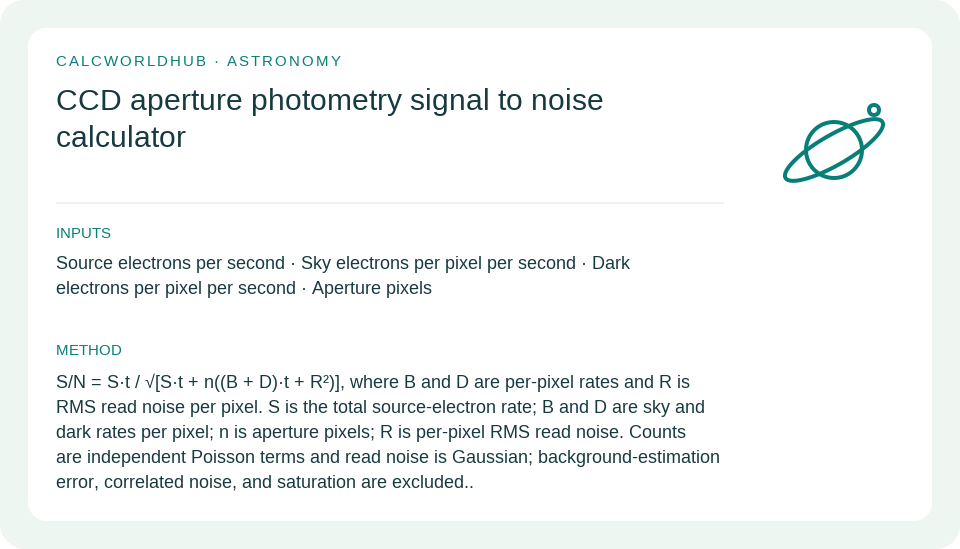
S/N = S·t / √[S·t + n((B + D)·t + R²)], where B and D are per-pixel rates and R is RMS read noise per pixel.
S is the total source-electron rate; B and D are sky and dark rates per pixel; n is aperture pixels; R is per-pixel RMS read noise. Counts are independent Poisson terms and read noise is Gaussian; background-estimation error, correlated noise, and saturation are excluded..
What to enter
s— Source electrons per second- Detected source-electron rate integrated over the source aperture.
b— Sky electrons per pixel per second- Sky-background electron rate for each aperture pixel; multiplied by the aperture pixel count and exposure.
d— Dark electrons per pixel per second- Detector dark-current electron rate per aperture pixel.
n— Aperture pixels- Number of pixels contributing source, sky, dark, and read-noise terms.
r— Read noise (electrons RMS/pixel)- RMS read noise per pixel; its variance contributes nR² for one exposure.
t— Exposure duration (s)- Integration time in seconds; source and sky/dark counts scale with this duration.
Interpreting the result
Independent Poisson electron counts and Gaussian read noise; background estimation error, correlated noise, and saturation are excluded.
Verified reference: European Southern Observatory, Exposure Time Calculator formulae.
Frequently asked questions
Are ADU values accepted?
Convert them to electrons using detector gain.
Does the sky term use the full aperture?
It is per pixel and multiplied by aperture pixels.
Does stacking require a different read term?
Yes, each exposure contributes another read.
How do I use the CCD aperture photometry signal to noise calculator?
Enter Source electrons per second, Sky electrons per pixel per second, Dark electrons per pixel per second, Aperture pixels, then complete the remaining labeled fields. Match the units shown beside each field and review the result together with the assumptions below.
What is a worked example of CCD aperture photometry signal to noise?
Source electrons per second = 100; Sky electrons per pixel per second = 2; Dark electrons per pixel per second = 0.1; Aperture pixels = 25; Read noise (electrons RMS/pixel) = 5; Exposure duration (s) = 60. CCD aperture photometry signal to noise: 60.686608 A 60 s exposure collects 6,000 source electrons. Sky plus dark current contribute 3,150 aperture electrons and read noise contributes 625 variance, so the stated independent-noise model gives S/N ≈ 60.69.
Read our calculation methodology.