How to use this calculator
Estimate certificate-of-deposit interest earned, an interest-days withdrawal penalty, and the remaining proceeds before maturity.
- Enter CD principal balance ($), Annual percentage yield APY (%), Days held so far (days), Early-withdrawal penalty (interest days). Match the units shown beside each field and review the result together with the assumptions below.
- Read the worked example below to check the expected input format and result.
- Compare another scenario by changing one input at a time. Use Reset to return to the starting values.
How this calculation works
A certificate of deposit may impose a disclosed cost when money is withdrawn before maturity. This estimator translates a contract penalty stated as a number of interest days into an approximate dollar amount and compares it with accrued interest; it is a scenario estimate, not a substitute for the account agreement.
Inputs and units
principal— CD principal balance ($)- Deposit amount subject to the early-withdrawal penalty.
apy— Annual percentage yield APY (%)- Enter the account’s effective annual yield as a percentage.
daysHeld— Days held so far (days)- Elapsed days used for the estimated accrued-interest calculation.
penaltyDays— Early-withdrawal penalty (interest days)- Use the interest-day period specified in the CD disclosure.
Formula
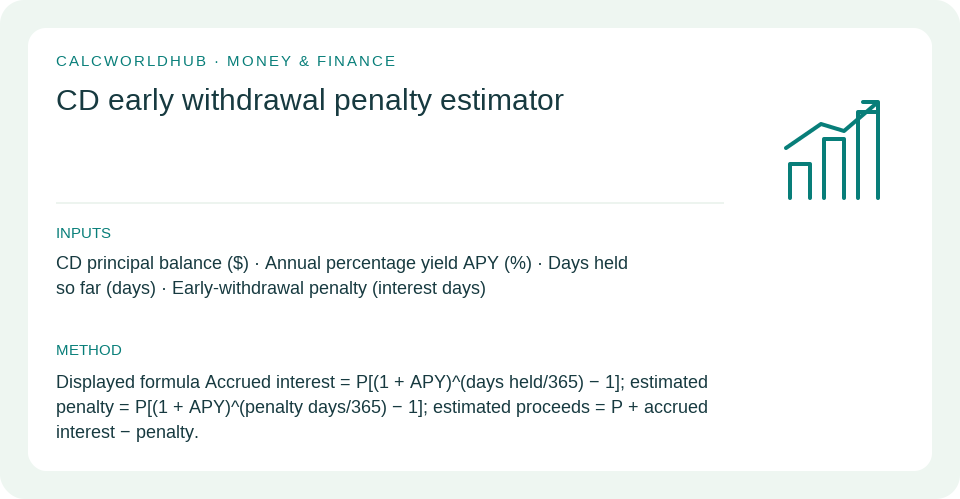
Accrued interest = P[(1 + APY)^(days held/365) − 1]; estimated penalty = P[(1 + APY)^(penalty days/365) − 1]; estimated proceeds = P + accrued interest − penalty.
Method
Treat the entered APY as an effective annual yield and prorate it over the entered actual-day fractions using fractional-year compounding. Apply the same method to the contract’s interest-days penalty, then subtract that penalty from principal plus estimated accrued interest.
Worked example
For $10,000 at 4.5% APY, held 180 days with a 90-interest-day penalty, estimated accrued interest is $219.44, the penalty is $109.13, and estimated proceeds are $10,110.32.
Assumptions and limits
Only models penalties expressed as a stated number of interest days. Financial institutions can use different day counts, simple-interest rules, balance bases, fixed fees, forfeited credited interest, or other contract terms. Verify the exact disclosure and maturity rules; the penalty can exceed accrued interest and reduce principal.
Frequently asked questions
Can the penalty be larger than interest earned?
Yes. Some contracts allow a penalty that exceeds interest accrued to date, which can reduce principal. This estimate shows negative net interest when that occurs.
Does every CD use an interest-days penalty?
No. Contracts differ. Enter the penalty rule from the specific account disclosure; fixed fees or other terms are outside this model.
Will this match the bank’s exact payoff quote?
Not necessarily. The bank may use a different day-count or compounding convention, credit interest on a schedule, or apply a contract-specific balance basis. Request the institution’s current withdrawal quote.
How do I use the CD early withdrawal penalty estimator?
Enter CD principal balance ($), Annual percentage yield APY (%), Days held so far (days), Early-withdrawal penalty (interest days). Match the units shown beside each field and review the result together with the assumptions below.
What is a worked example of CD early withdrawal penalty estimator?
For $10,000 at 4.5% APY, held 180 days with a 90-interest-day penalty, estimated accrued interest is $219.44, the penalty is $109.13, and estimated proceeds are $10,110.32.
Reference: Consumer Financial Protection Bureau certificate-of-deposit and early-withdrawal guidance. See our calculation methodology.