Monthly savings deposits future value calculator
Accumulate equal end-of-month deposits at a monthly rate. Enter your values below for a free estimate, with no account required.
Calculator
How to use this calculator
Free Monthly savings deposits future value calculator. Accumulate equal end-of-month deposits at a monthly rate.
- Enter Monthly deposit ($), Monthly rate (%), Number of months. Match the units shown beside each field and review the result together with the assumptions below.
- Read the worked example below to check the expected input format and result.
- Compare another scenario by changing one input at a time. Use Reset to return to the starting values.
How monthly deposits grow to a future value
This calculator projects equal deposits made at the end of every month. It reports the future value of those deposits only; it does not include an opening balance or compare the result with a target.
Inputs and units
- Monthly deposit ($): Enter the amount deposited at each month-end in the currency you want reported.
- Monthly rate (%): Enter the effective interest rate for one month as a percent. For example, 0.5 means 0.5% per month.
- Number of months: Enter a positive whole number of deposits and compounding periods.
Formula and method
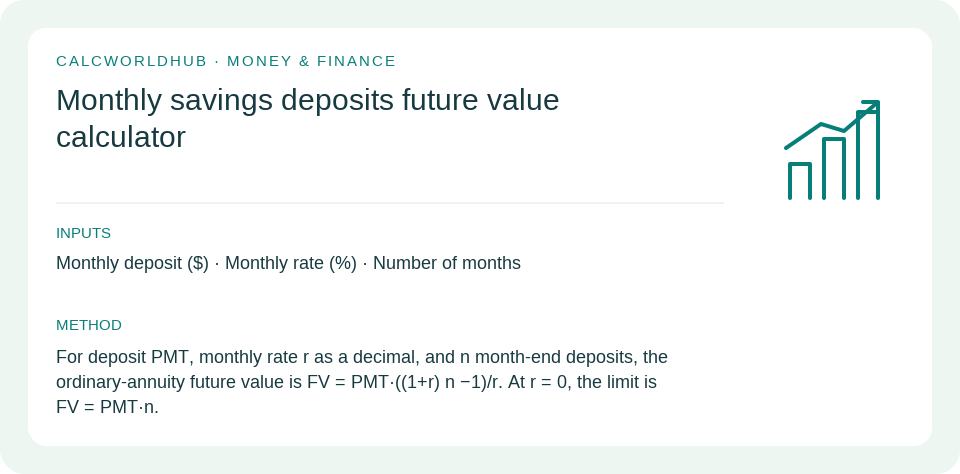
For deposit PMT, monthly rate r as a decimal, and n month-end deposits, the ordinary-annuity future value is FV = PMT·((1+r)n−1)/r. At r = 0, the limit is FV = PMT·n.
Worked example
Depositing $250 at the end of each month for 48 months at 0.5% per month gives FV = 250·((1.005)48−1)/0.005 = $13,524.4581, or about $13,524.46 before account-specific rounding.
Interpreting the result
The result is the accumulated value of the deposit stream after the final month’s interest period. It can be compared across deposit, rate, or term scenarios only when the timing and rate definitions stay consistent.
Assumptions and limits
The rate is fixed and compounded monthly, and each deposit arrives at the end of its month. The model excludes an initial balance, taxes, fees, rate changes, missed deposits, inflation, and account-specific rules. To include money already saved, use a starting-balance projection.
Frequently asked questions
Does this include money already in the account?
No. The result contains only the future value of the monthly deposits. Use a starting-balance projection when an opening amount should also earn interest.
What does a zero monthly rate return?
With no interest growth, the future value is the monthly deposit multiplied by the number of deposits.
When is each deposit made?
At the end of each month, which is the ordinary-annuity convention. Beginning-of-month deposits would earn an extra month of interest.
Is the rate an annual percentage?
No. The input is the effective rate for one month. Use the account’s monthly rate, not an annual percentage copied without conversion.
How do I use the Monthly savings deposits future value calculator?
Enter Monthly deposit ($), Monthly rate (%), Number of months. Match the units shown beside each field and review the result together with the assumptions below.
Related calculators
- Monthly deposit needed for a savings target — solve for a deposit instead of projecting one.
- Starting savings balance future value — project an opening balance.
- Ordinary annuity future value — compare the general end-of-period payment model.
- Combined savings balance projection — include both an opening balance and regular deposits.
Sources
The end-of-period timing and ordinary-annuity equation follow OpenStax, Methods of Savings. Investor.gov’s Compound Interest Calculator also distinguishes monthly contributions, an initial investment, and compounding frequency.
Read the calculation methodology and privacy policy.
Good calculators show their work.
CalcWorldHub is built around clear inputs and visible assumptions. Results are estimates for planning; check official sources or your provider’s terms when exact figures matter.