Ordinary annuity future value calculator
Accumulate fixed end-of-period payments at a periodic rate. Enter your values below for a free estimate, with no account required.
inputs.
Calculator
How to use the Ordinary annuity future value calculator
Accumulate fixed end-of-period payments at a periodic rate. Enter your values below for a free estimate, with no account required.
What this calculator measures
Find the future value of equal payments made at the end of each period and accumulated at a constant periodic interest rate.
Inputs and units
The required fields are Periodic payment ($), Periodic interest rate (%), Number of payments, Discount rate per period (%). Each value should describe the same object, sample, transaction, or time period wherever the formula compares them.
- Periodic payment ($): Use the same currency and accounting period as the other money fields in this calculation.
- Periodic interest rate (%): Enter a percentage in the format shown; do not switch between a whole percent and a decimal fraction.
- Number of payments: Use a whole-number count when the field represents discrete trials, items, people, or periods.
Formula and method
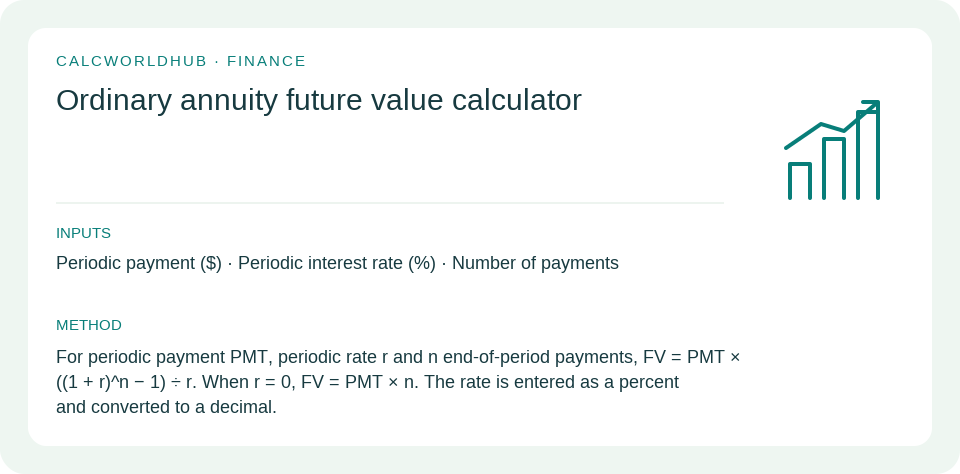
For periodic payment PMT, periodic rate r and n end-of-period payments, FV = PMT × ((1 + r)^n − 1) ÷ r. When r = 0, FV = PMT × n. The rate is entered as a percent and converted to a decimal.
Worked example
Depositing $300 at the end of each month for 36 months at 0.5% per month gives FV = 300 × ((1.005^36 − 1) ÷ 0.005) ≈ $11,800.83. At a 0% rate, the same deposits total $10,800.
How to use the calculator
- Read the field labels and select values from the same source and measurement basis.
- Enter Periodic payment ($) and the other required values. Use the units printed on the page and convert mixed units first.
- Review the displayed method, then compare the result with the question you are trying to answer.
- Change one input at a time to see which assumption has the greatest effect on the result.
Interpreting the result
This is the accumulated balance at the time of the last scheduled payment under the entered rate. It is not the present value of the payments; changing the payment timing to the beginning of each period would produce an annuity-due value.
Assumptions and limits
Payments occur at the end of each period, and the rate remains constant with the same compounding period as the payment interval. The result excludes taxes, fees, inflation, and changes to contributions or returns. A zero periodic rate is valid and returns PMT × n.
Match the rate, compounding frequency, currency, and time period. Taxes, fees, inflation, and contract-specific terms affect a real decision only when they are included in the inputs or method.
Frequently asked questions
What information do I need?
Enter the payment amount, interest rate per payment period as a percent, and a nonnegative whole number of payments. Do not enter the rate as a decimal fraction unless you first convert it to percent.
How should I interpret the result?
The future value includes each end-of-period payment plus the growth earned on earlier payments. With a 0% rate it reduces to payment amount × payment count.
Is the Ordinary annuity future value calculator free to use?
Yes. This calculator is free and works in your browser without an account.
How do I use the Ordinary annuity future value calculator?
Enter Periodic payment ($), Periodic interest rate (%), Number of payments. Match the units shown beside each field and review the result together with the assumptions below.
What is a worked example of Ordinary annuity future value?
Depositing $300 at the end of each month for 36 months at 0.5% per month gives FV = 300 × ((1.005^36 − 1) ÷ 0.005) ≈ $11,800.83. At a 0% rate, the same deposits total $10,800.
Read the calculation methodology and privacy policy.
Good calculators show their work.
CalcWorldHub is built around clear inputs and visible assumptions. Results are estimates for planning; check official sources or your provider’s terms when exact figures matter.