Ordinary annuity present value calculator
Discount a fixed end-of-period payment stream to present value. Enter your values below for a free estimate, with no account required.
inputs.
Calculator
How to use the Ordinary annuity present value calculator
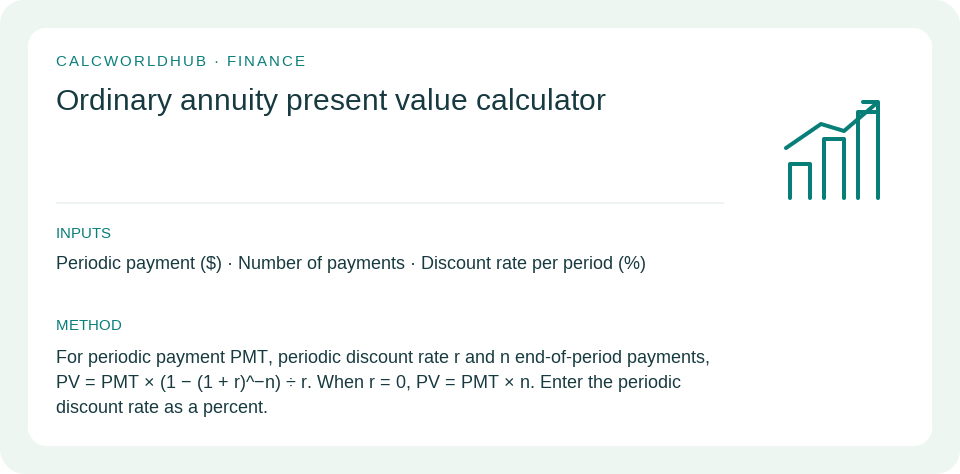
Discount a fixed end-of-period payment stream to present value. Enter your values below for a free estimate, with no account required.
What this calculator measures
Find today’s value of equal payments made at the end of each period, discounted at one constant rate per period.
Inputs and units
The required fields are Periodic payment ($), Periodic interest rate (%), Number of payments, Discount rate per period (%). Each value should describe the same object, sample, transaction, or time period wherever the formula compares them.
- Periodic payment ($): Use the same currency and accounting period as the other money fields in this calculation.
- Number of payments: Use a whole-number count when the field represents discrete trials, items, people, or periods.
- Discount rate per period (%): Enter a percentage in the format shown; do not switch between a whole percent and a decimal fraction.
Formula and method
For periodic payment PMT, periodic discount rate r and n end-of-period payments, PV = PMT × (1 − (1 + r)^−n) ÷ r. When r = 0, PV = PMT × n. Enter the periodic discount rate as a percent.
Worked example
For $300 paid at each month-end for 36 months and a 0.4% monthly discount rate, PV = 300 × (1 − 1.004^−36) ÷ 0.004 ≈ $10,039.76. At a 0% discount rate, PV is $10,800.
How to use the calculator
- Read the field labels and select values from the same source and measurement basis.
- Enter Periodic payment ($) and the other required values. Use the units printed on the page and convert mixed units first.
- Review the displayed method, then compare the result with the question you are trying to answer.
- Change one input at a time to see which assumption has the greatest effect on the result.
Interpreting the result
Present value expresses the future payment stream in today’s units under the entered periodic discount rate. A beginning-of-period payment stream would have a higher value by one period of discounting.
Assumptions and limits
Payments are equal, occur at the end of each period, and use the same frequency as the entered discount rate. The result excludes taxes, fees, inflation, payment default, and changes in the rate. A zero discount rate is valid and gives PMT × n.
Match the rate, compounding frequency, currency, and time period. Taxes, fees, inflation, and contract-specific terms affect a real decision only when they are included in the inputs or method.
Frequently asked questions
What information do I need?
Enter the payment amount, periodic discount rate as a percent, and a nonnegative whole number of end-of-period payments. The discount-rate period must match the payment interval.
How should I interpret the result?
The present value discounts later payments more than earlier ones. With a 0% rate, discounting has no effect and the result is payment amount × payment count.
Is the Ordinary annuity present value calculator free to use?
Yes. This calculator is free and works in your browser without an account.
How do I use the Ordinary annuity present value calculator?
Enter Periodic payment ($), Number of payments, Discount rate per period (%). Match the units shown beside each field and review the result together with the assumptions below.
What is a worked example of Ordinary annuity present value?
For $300 paid at each month-end for 36 months and a 0.4% monthly discount rate, PV = 300 × (1 − 1.004^−36) ÷ 0.004 ≈ $10,039.76. At a 0% discount rate, PV is $10,800.
Read the calculation methodology and privacy policy.
Good calculators show their work.
CalcWorldHub is built around clear inputs and visible assumptions. Results are estimates for planning; check official sources or your provider’s terms when exact figures matter.