Centrifuge RPM from RCF calculator
Find the rotor speed needed to produce a target relative centrifugal force. Enter your values below to see the result and method.
inputs.
Related calculators
These tools cover nearby questions while keeping this page focused on its own calculation.
How to use this calculator
Find the rotor speed needed to produce a target relative centrifugal force.
- Enter Target RCF (× g), Rotor radius (cm). Match the units shown beside each field and review the result together with the assumptions below.
- Read the worked example below to check the expected input format and result.
- Compare another scenario by changing one input at a time. Use Reset to return to the starting values.
Convert target RCF to rotor speed
Find the rotational speed that produces a requested relative centrifugal force at the sample radius. This is useful when a protocol gives × g but the centrifuge accepts RPM.
What it calculates
The result is revolutions per minute for the selected RCF and radius. RCF is a ratio to standard gravity, written × g; it is not an acceleration in m/s².
Inputs and units
- Target RCF (× g)
- The relative centrifugal force specified by the method or protocol.
- Rotor radius (cm)
- Distance in centimetres from the rotor’s axis to the sample location, using the instrument manufacturer’s convention.
Formula and worked example
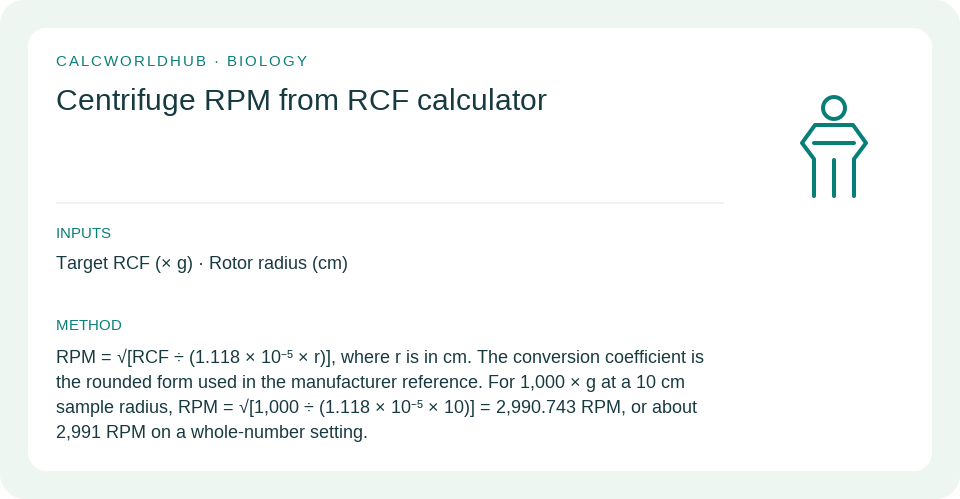
RPM = √[RCF ÷ (1.118 × 10⁻⁵ × r)], where r is in cm. The conversion coefficient is the rounded form used in the manufacturer reference.
For 1,000 × g at a 10 cm sample radius, RPM = √[1,000 ÷ (1.118 × 10⁻⁵ × 10)] = 2,990.743 RPM, or about 2,991 RPM on a whole-number setting.
Reading the result
For the same target force, increasing the radius lowers the required RPM according to a square-root relationship. Confirm the real sample radius rather than substituting the rotor’s maximum radius automatically.
Assumptions and limitations
This uses a standard conversion based on radius and rotational speed. It does not account for rotor adapters, acceleration profiles, run time, temperature, or sample-specific sedimentation. Follow the centrifuge manual and protocol, and verify that the rotor and tubes are rated for the requested setting.
Source and method reference
The reference gives RCF = 1.118 × 10⁻⁵ × radius in cm × RPM² and defines radius from the rotor center to the sample. Thermo Fisher Scientific centrifuge speed conversion note.
Frequently asked questions
Which rotor radius should I use?
Use the distance from the rotor axis to the sample location, following the radius convention used by the rotor manufacturer and protocol.
Why can the required RPM differ between rotors?
At a fixed target RCF, RPM varies with the inverse square root of radius. A rotor with a larger effective radius needs a lower speed for the same RCF.
Does this result confirm that the rotor is safe at that speed?
No. Check the manufacturer’s RPM and RCF ratings and the protocol’s time, temperature, and tube requirements.
How do I use the Centrifuge RPM from RCF calculator?
Enter Target RCF (× g), Rotor radius (cm). Match the units shown beside each field and review the result together with the assumptions below.
What is a worked example of Centrifuge RPM from RCF?
RPM = √[RCF ÷ (1.118 × 10⁻⁵ × r)], where r is in cm. The conversion coefficient is the rounded form used in the manufacturer reference. For 1,000 × g at a 10 cm sample radius, RPM = √[1,000 ÷ (1.118 × 10⁻⁵ × 10)] = 2,990.743 RPM, or about 2,991 RPM on a whole-number setting.
Read the calculation methodology.