Relative centrifugal force from RPM calculator
Convert centrifuge speed and rotor radius to relative centrifugal force. Enter your values below to see the result and method.
inputs.
Related calculators
These tools cover nearby questions while keeping this page focused on its own calculation.
How to use this calculator
Convert centrifuge speed and rotor radius to relative centrifugal force.
- Enter Rotor radius (cm), Speed (RPM). Match the units shown beside each field and review the result together with the assumptions below.
- Read the worked example below to check the expected input format and result.
- Compare another scenario by changing one input at a time. Use Reset to return to the starting values.
Convert rotor speed and sample radius to RCF
Estimate the relative centrifugal force produced by a centrifuge at a given RPM. The sample radius matters because the force increases with distance from the rotor axis.
What it calculates
The result is relative centrifugal force in multiples of standard gravity (× g). It is a force ratio for the entered radius and speed, not a centrifuge-time recommendation.
Inputs and units
- Rotor radius (cm)
- Distance in centimetres from the rotation axis to the sample location.
- Speed (RPM)
- Rotor revolutions per minute for the selected operating setting.
Formula and worked example
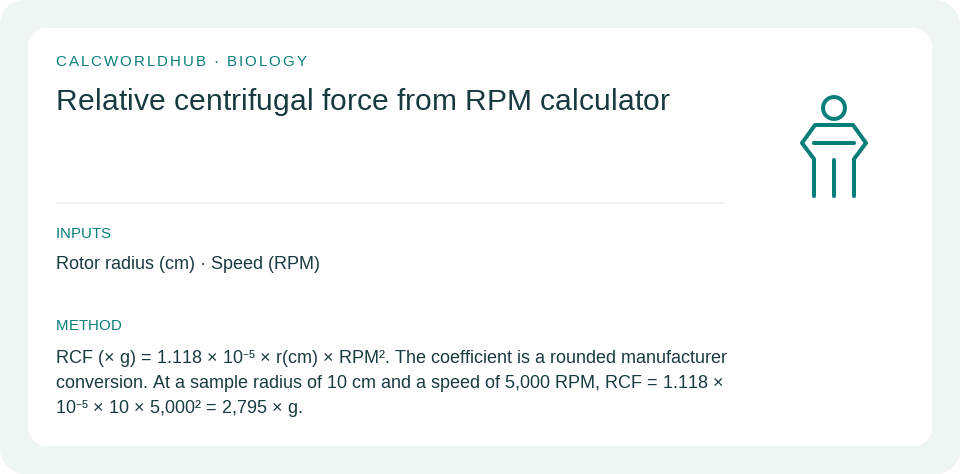
RCF (× g) = 1.118 × 10⁻⁵ × r(cm) × RPM². The coefficient is a rounded manufacturer conversion.
At a sample radius of 10 cm and a speed of 5,000 RPM, RCF = 1.118 × 10⁻⁵ × 10 × 5,000² = 2,795 × g.
Reading the result
RCF scales linearly with radius and with the square of speed. A fourfold force increase at the same radius therefore requires twice the RPM; it does not mean the protocol run time should be divided by four.
Assumptions and limitations
This conversion uses a constant rotor radius and steady rotational speed. It does not model ramp-up, braking, tube position changes, run time, or biological yield. Use the sample radius convention and operating limits in the rotor manual and protocol.
Source and method reference
The reference defines the conversion coefficient, centimetre radius, and RPM convention used here. Thermo Fisher Scientific centrifuge speed conversion note.
Frequently asked questions
Where is the rotor radius measured?
Measure from the rotation axis to the sample location, using the convention stated by the rotor manufacturer.
What does the × g result mean?
It is centrifugal acceleration expressed as a multiple of standard gravity, not acceleration in m/s².
Does doubling RPM double RCF?
No. RCF is proportional to RPM squared, so doubling speed multiplies RCF by four when the radius stays fixed.
How do I use the Relative centrifugal force from RPM calculator?
Enter Rotor radius (cm), Speed (RPM). Match the units shown beside each field and review the result together with the assumptions below.
What is a worked example of Relative centrifugal force from RPM?
RCF (× g) = 1.118 × 10⁻⁵ × r(cm) × RPM². The coefficient is a rounded manufacturer conversion. At a sample radius of 10 cm and a speed of 5,000 RPM, RCF = 1.118 × 10⁻⁵ × 10 × 5,000² = 2,795 × g.
Read the calculation methodology.