Centripetal force calculator
Estimate the inward net force for an object moving at a chosen speed and radius.
inputs.
Calculator

How to use this calculator
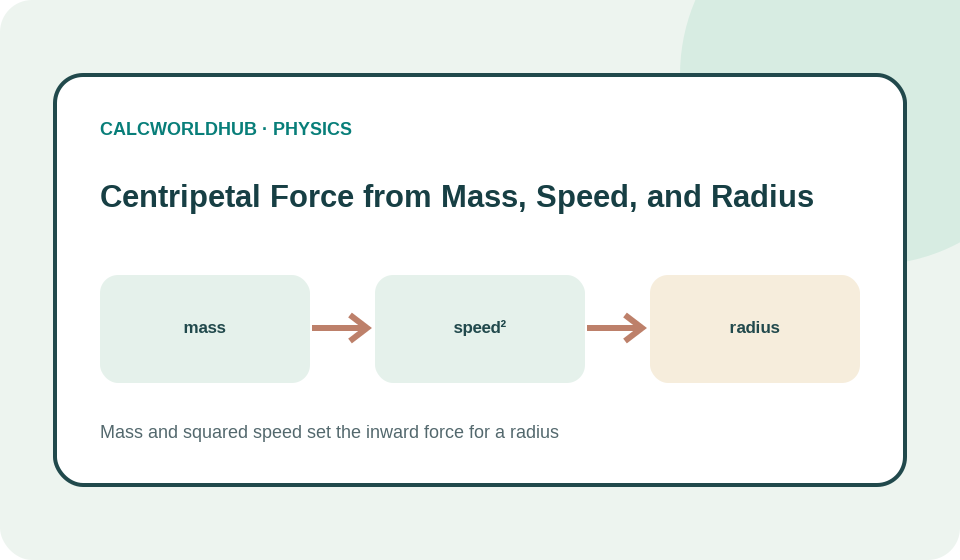
Calculate inward centripetal force from mass, tangential speed, and circular path radius.
- Enter Mass (kg), Speed (m/s), Radius (m). Match the units shown beside each field and review the result together with the assumptions below.
- Read the worked example below to check the expected input format and result.
- Compare another scenario by changing one input at a time. Use Reset to return to the starting values.
Estimate the inward net force required for circular motion
For an object moving at constant speed around a circular path, the required net force points toward the center. Its magnitude depends on mass, speed, and path radius.
Inputs and units
- Mass (kg): Object mass in kilograms.
- Speed (m/s): Tangential speed magnitude along the circular path.
- Radius (m): Radius of the circular path; it must be positive.
Formula and method
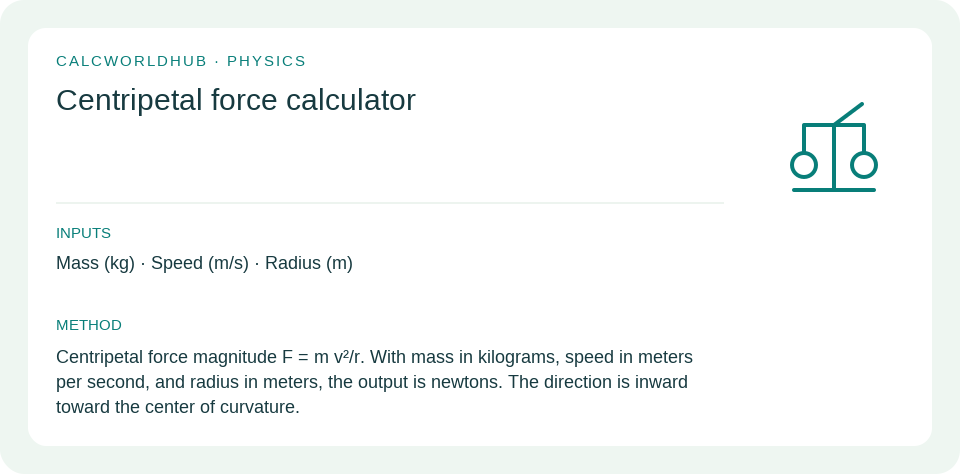
Centripetal force magnitude F = m v²/r. With mass in kilograms, speed in meters per second, and radius in meters, the output is newtons. The direction is inward toward the center of curvature.
Worked example
For a 2 kg object moving at 5 m/s on a path of radius 3 m, F = 2 × 5² ÷ 3 = 50/3 ≈ 16.67 N inward.
Interpreting the result
About 16.67 N of inward net force is required in this example to maintain the circular path at that speed. Tension, friction, gravity, or a combination may supply that net force in a real situation.
Assumptions and limits
This is a constant-radius magnitude calculation. It does not identify which physical interaction supplies the force, model speed changes along the path, or include a force diagram for a specific system.
Method references
Frequently asked questions
Is centripetal force a separate kind of force?
No. It names the inward net force needed for circular motion. Tension, friction, gravity, or another interaction can provide it.
How do I use the Centripetal force calculator?
Enter Mass (kg), Speed (m/s), Radius (m). Match the units shown beside each field and review the result together with the assumptions below.
What is a worked example of Centripetal force?
For a 2 kg object moving at 5 m/s on a path of radius 3 m, F = 2 × 5² ÷ 3 = 50/3 ≈ 16.67 N inward.
What does the Centripetal force calculator calculate?
Calculate inward centripetal force from mass, tangential speed, and circular path radius.
What assumptions apply to Centripetal force?
This is a constant-radius magnitude calculation. It does not identify which physical interaction supplies the force, model speed changes along the path, or include a force diagram for a specific system.
Good calculators show their work.
CalcWorldHub is built around clear inputs and visible assumptions. Results are estimates for planning; check official sources or your provider’s terms when exact figures matter.