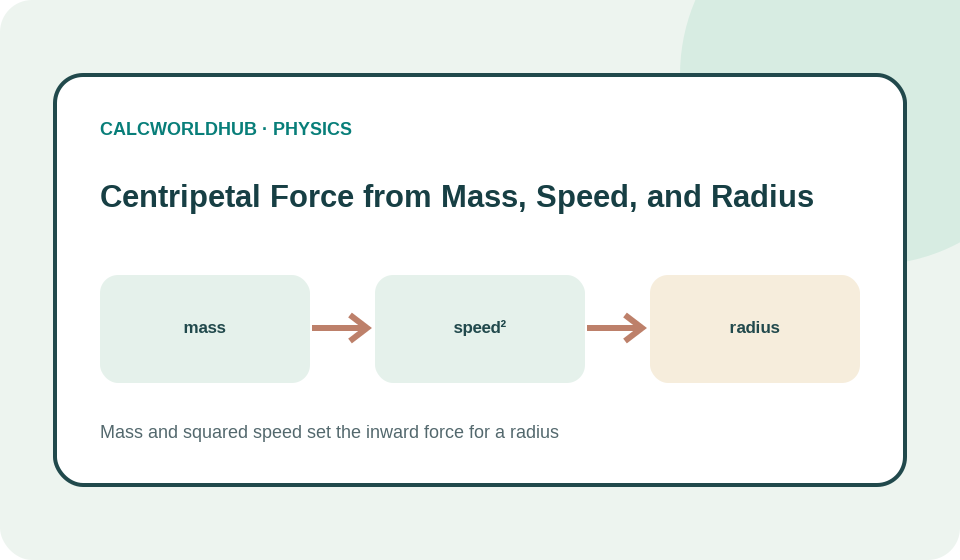

Find the inward net force for a turn
“Centripetal” describes the inward direction of the net force toward the center of a circular path. It is not an extra type of force to add to gravity, tension, friction, or a normal force. In an actual setup, those physical forces combine to provide the required inward net force. Keeping that distinction prevents double-counting a separate “centripetal force.”
Use mass, speed, and radius in SI units
Enter mass in kilograms, speed in metres per second, and radius in metres. Radius is the distance from the center of the circular path to the object’s path, not the diameter. Convert speed and distance before using the formula; using kilometres per hour or centimetres without conversion changes the result by squared or linear scale factors.
Why speed is squared
For uniform circular motion, Fc = m v²/r. Mass scales the required force linearly, speed is squared, and radius is in the denominator. Doubling speed therefore requires four times the inward net force if mass and radius are unchanged, while doubling the radius halves the force at the same speed.
Interpret the direction and role of force
The output is a force magnitude in newtons. Direction is inward, toward the center; the calculator does not return a vector or determine which component of force produces it. OpenStax derives the relation from Newton’s second law and centripetal acceleration, linking the result to the net radial acceleration rather than to a special force source.
Apply the model to circular motion
Use the equation to estimate tire-road friction demand on a level turn, tension in a rotating system, or a basic orbital-scale force check, but match the physical assumptions to the situation. Banking, drag, gravity, friction limits, nonuniform speed, and changing radius can all affect the actual force balance.
The squared speed also magnifies unit mistakes. If speed is entered in kilometres per hour as though it were metres per second, the calculated force is too large by the square of 3.6. A quick dimensional check helps: kg×(m/s)²÷m reduces to kg·m/s², which is a newton. Keep that check with the conversion when using field measurements.
The equation can describe the radial force requirement without naming its physical source. A vehicle turning on a level road may rely mainly on tire friction, while a satellite relies on gravity; in both cases the net inward force must match the motion. If the available force is too small, the object will not follow the chosen radius at that speed. The estimate is therefore useful for comparing requirements, not a direct measurement of grip, engine output, or structural load.
Worked examples
All inputs are converted to kilograms, metres, and metres per second before evaluating the force.
A two-kilogram object on a broad circle
Inputs: Mass m = 2 kg; speed v = 5 m/s; radius r = 3 m.
Calculation: Fc = mv²/r = 2×5²/3 = 50/3 = 16.6666667 N inward.
The required inward net force is approximately 16.67 N.
A compact object moving through a tighter curve
Inputs: Mass m = 0.145 kg; speed v = 13.9 m/s; radius r = 0.31 m.
Calculation: Fc = 0.145×13.9²/0.31 = 28.01545/0.31 = 90.37241935 N inward.
The model gives an inward force magnitude of about 90.37 N.

Assumptions behind the calculation
For a vehicle, the required inward force must be supplied by the net horizontal tire-road interaction together with any banked-road component. The calculator’s output does not assess traction, tire condition, road friction, or safe speed. It is a dynamics calculation, not a driving recommendation or a full vehicle handling model.
The equation assumes the entered speed and radius describe the same circular path at the same time. For a noncircular path, changing speed, or a rotating body whose point has a different radius, use the relevant instantaneous acceleration model. The mass is treated as a point mass at the specified radius, without a distribution-of-mass or structural stress calculation.