How to use this calculator
Convert chlorine mass feed and water flow to dose, then subtract a measured chlorine residual to estimate demand.
- Enter Available chlorine feed, F (kg Cl₂/day), Water flow, Q (m³/day), Measured chlorine residual, Cᵣ (mg/L as Cl₂). Match the units shown beside each field and review the result together with the assumptions below.
- Read the worked example below to check the expected input format and result.
- Compare another scenario by changing one input at a time. Use Reset to return to the starting values.
How this calculation works
Enter the chlorine feed mass rate, water flow rate, and a measured residual after the chosen contact time. The calculator converts the feed to an applied concentration as Cl₂ and subtracts the residual to estimate chlorine demand.
Inputs and units
chlorineFeedKgDay— Available chlorine feed, F (kg Cl₂/day)- Mass rate of chlorine expressed as Cl₂ equivalent; zero is allowed.
waterFlowM3Day— Water flow, Q (m³/day)- Water volume treated per day; must be positive.
measuredResidualMgL— Measured chlorine residual, Cᵣ (mg/L as Cl₂)- Residual measured after the chosen contact time and reported on the same Cl₂ basis.
Formula
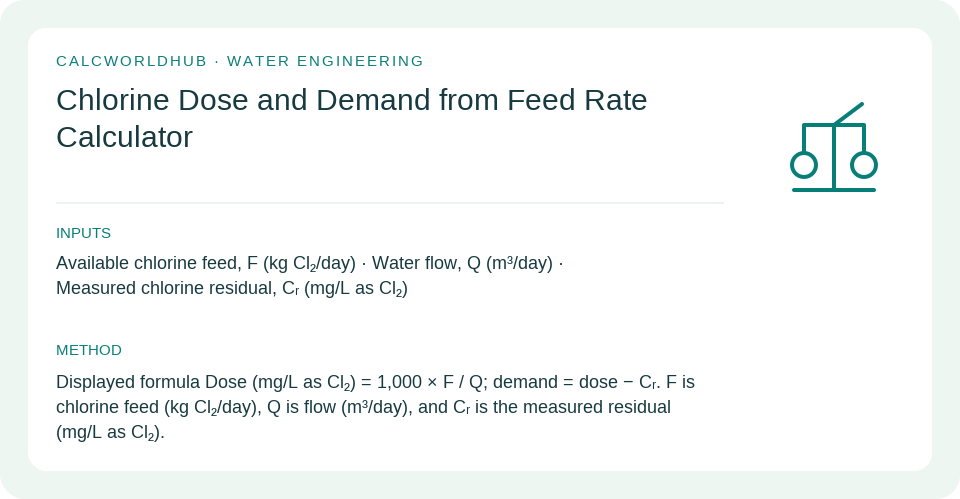
Dose (mg/L as Cl₂) = 1,000 × F / Q; demand = dose − Cᵣ. F is chlorine feed (kg Cl₂/day), Q is flow (m³/day), and Cᵣ is the measured residual (mg/L as Cl₂).
Method
Convert feed mass per day and water volume per day to the same concentration basis: 1 kg/m³ equals 1,000 mg/L. Subtract the measured residual from the applied dose.
Worked example
A feed of 2 kg Cl₂/day into 2,500 m³/day gives a dose of 0.8 mg/L as Cl₂. If the residual after the selected contact time is 0.3 mg/L, the estimated chlorine demand is 0.5 mg/L.
Assumptions and limits
Use a residual measured after a stated, consistent contact time and expressed on the same Cl₂ basis as the feed. Chlorine demand changes with time, pH, temperature, and water constituents. This mass-balance estimate does not establish disinfection adequacy or replace a CT calculation.
Frequently asked questions
How is chlorine dose calculated from feed and flow?
A mass feed of kg/day divided by a flow of m³/day gives kg/m³; multiply by 1,000 to express that concentration as mg/L.
How should residual be measured?
Use the measured residual after the contact time relevant to your operating or test condition, and express it on the same chlorine-equivalent basis as the feed.
Does demand show that disinfection is adequate?
No. Demand is the dose consumed before residual remains. Disinfection adequacy depends on applicable treatment requirements and conditions such as residual, contact time, pH, and temperature.
How do I use the Chlorine Dose and Demand from Feed Rate Calculator?
Enter Available chlorine feed, F (kg Cl₂/day), Water flow, Q (m³/day), Measured chlorine residual, Cᵣ (mg/L as Cl₂). Match the units shown beside each field and review the result together with the assumptions below.
What is a worked example of Chlorine Dose and Demand from Feed Rate?
A feed of 2 kg Cl₂/day into 2,500 m³/day gives a dose of 0.8 mg/L as Cl₂. If the residual after the selected contact time is 0.3 mg/L, the estimated chlorine demand is 0.5 mg/L.
Reference: U.S. EPA wastewater operations manual on chlorine feed, dose, residual, and demand. See our calculation methodology.