How to use this calculator
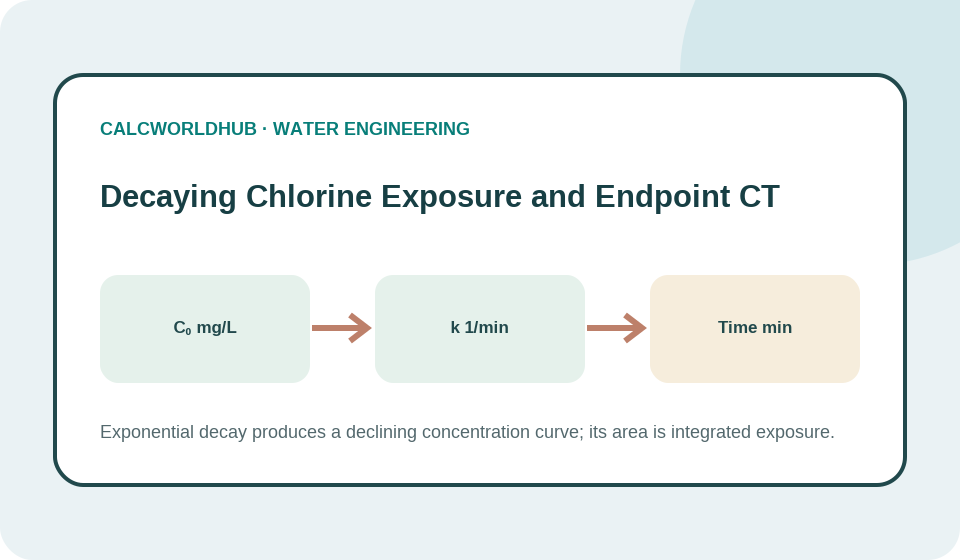
Compare true exposure along a parcel with the endpoint-residual-times-time shortcut when chlorine decays during contact.
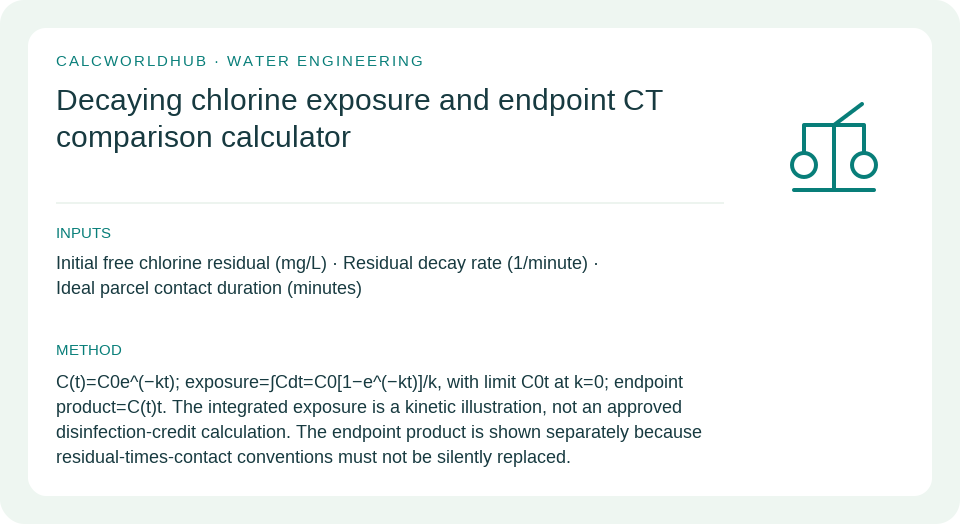
- Enter Initial free chlorine residual (mg/L), Residual decay rate (1/minute), Ideal parcel contact duration (minutes). Match the units shown beside each field and review the result together with the assumptions below.
- Read the worked example below to check the expected input format and result.
- Compare another scenario by changing one input at a time. Use Reset to return to the starting values.
Decaying chlorine exposure and endpoint CT comparison explained
A numerical walkthrough
Initial free chlorine residual (mg/L) = 2; Residual decay rate (1/minute) = 0.03; Ideal parcel contact duration (minutes) = 30.
- Integrated parcel chlorine exposure: 39.562023 mg minute/L
- Endpoint chlorine residual: 0.813139 mg/L
- Endpoint residual times contact time: 24.39418 mg minute/L
A parcel starts at 2 mg/L after immediate chlorine demand, decays at 0.03/min and travels for 30 minutes. Exposure accumulates while its residual declines.
The model behind the numbers
C(t)=C0e^(−kt); exposure=∫Cdt=C0[1−e^(−kt)]/k, with limit C0t at k=0; endpoint product=C(t)t.
The integrated exposure is a kinetic illustration, not an approved disinfection-credit calculation. The endpoint product is shown separately because residual-times-contact conventions must not be silently replaced.
What to enter
C0— Initial free chlorine residual (mg/L)- Residual after immediate demand has already been satisfied at the start of ideal parcel contact.
k— Residual decay rate (1/minute)- Natural-exponential first-order decay rate measured for the modeled water.
t— Ideal parcel contact duration (minutes)- Physical contact time of one plug-flow parcel; not automatically an approved T10.
Interpreting the result
Ideal plug-flow parcel and constant first-order decay; no rapid initial demand, wall demand, variable temperature or residence-time distribution. Regulatory CT requires the applicable residual, contact-time and approval framework. Educational model; this is not a code-compliant design check.
Reading the outputs
Integrated exposure and endpoint product are mg·min/L; endpoint residual is mg/L. None of these values alone establishes pathogen removal credit.
Frequently asked questions
Can integrated exposure replace a required CT value?
Not automatically. Use the applicable approved contact-time and residual convention; this page provides no compliance or inactivation credit.
What does zero decay return?
A constant residual C0 and identical integrated exposure and endpoint product C0t.
Is hydraulic volume divided by flow always the contact time?
It is only nominal residence time; short-circuiting and an approved effective contact time can differ.
How do I use the Decaying chlorine exposure and endpoint CT comparison calculator?
Enter Initial free chlorine residual (mg/L), Residual decay rate (1/minute), Ideal parcel contact duration (minutes). Match the units shown beside each field and review the result together with the assumptions below.
What is a worked example of Decaying chlorine exposure and endpoint CT comparison?
Initial free chlorine residual (mg/L) = 2; Residual decay rate (1/minute) = 0.03; Ideal parcel contact duration (minutes) = 30. Integrated parcel chlorine exposure: 39.562023 mg minute/L Endpoint chlorine residual: 0.813139 mg/L Endpoint residual times contact time: 24.39418 mg minute/L A parcel starts at 2 mg/L after immediate chlorine demand, decays at 0.03/min and travels for 30 minutes. Exposure accumulates while its residual declines.
Background or definition reference: EPA Disinfection Profiling and Benchmarking Technical Guidance.
Read our calculation methodology.