How to use this calculator
Illustrate transient pollutant exchange between a well-mixed lake water column and one sediment compartment.
- Enter Lake mixed water volume (m³), Water throughflow (m³/day), Inflow concentration (mg/L), Initial lake concentration (mg/L), then complete the remaining labeled fields. Match the units shown beside each field and review the result together with the assumptions below.
- Read the worked example below to check the expected input format and result.
- Compare another scenario by changing one input at a time. Use Reset to return to the starting values.
Mixed lake sediment exchange pollutant transient explained
Use Lake mixed water volume (m³) with Water throughflow (m³/day) to reproduce the sample calculation, then review the stated limits before carrying the result into another scenario.
A numerical walkthrough
Lake mixed water volume (m³) = 100000; Water throughflow (m³/day) = 5000; Inflow concentration (mg/L) = 0.05; Initial lake concentration (mg/L) = 0.2; Initial exchangeable sediment mass (g) = 20000; Water-column decay rate (1/day) = 0.01; Settling transfer rate (1/day) = 0.03; Sediment release rate (1/day) = 0.005; External pollutant load (g/day) = 100; Assessment time (days) = 30.
- Lake water concentration: 0.062562 mg/L
- Exchangeable sediment pollutant mass: 25.697897 kg
- Total modeled water plus sediment mass: 31.954076 kg
A 100,000 m³ lake starts at 0.2 mg/L with 20 kg exchangeable sediment mass, receives 5000 m³/day at 0.05 mg/L plus 100 g/day, and is followed for 30 days.
The model behind the numbers
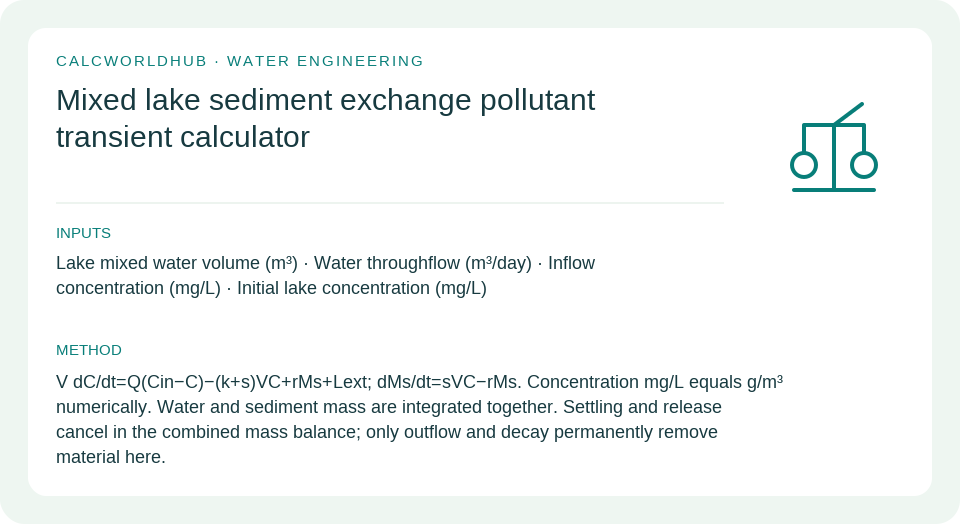
V dC/dt=Q(Cin−C)−(k+s)VC+rMs+Lext; dMs/dt=sVC−rMs. Concentration mg/L equals g/m³ numerically.
Water and sediment mass are integrated together. Settling and release cancel in the combined mass balance; only outflow and decay permanently remove material here.
What to enter
V— Lake mixed water volume (m³)- Constant well-mixed water volume.
Q— Water throughflow (m³/day)- Equal inflow and outflow volume rates.
Cin— Inflow concentration (mg/L)- Dissolved or suspended constituent concentration entering throughflow.
C0— Initial lake concentration (mg/L)- Constituent concentration in lake water at time zero.
M0— Initial exchangeable sediment mass (g)- Pollutant mass in one modeled exchangeable sediment store.
k— Water-column decay rate (1/day)- Irreversible first-order removal from lake water.
s— Settling transfer rate (1/day)- First-order transfer from water-column mass to the exchangeable sediment store.
r— Sediment release rate (1/day)- First-order return of the stored pollutant to water.
load— External pollutant load (g/day)- Additional mass loading besides inflow concentration.
t— Assessment time (days)- Time since the stated initial water and sediment conditions.
Interpreting the result
One mixed water compartment and one linear exchangeable sediment store. No spatial stratification, capacity limit, burial or concentration-dependent partition is represented. Educational model; this is not a code-compliant design check.
Reading the outputs
The primary result is water concentration in mg/L; the two mass outputs are kg in the sediment store and the combined modeled system.
Sources
Frequently asked questions
Does settling destroy pollutant mass?
No. Settling transfers mass from the water compartment into the exchangeable sediment pool.
Is this the EPA WASP model?
No. It uses a simplified two-compartment balance for illustration; EPA WASP is a broader water-quality modeling framework.
How do I use the Mixed lake sediment exchange pollutant transient calculator?
Enter Lake mixed water volume (m³), Water throughflow (m³/day), Inflow concentration (mg/L), Initial lake concentration (mg/L), then complete the remaining labeled fields. Match the units shown beside each field and review the result together with the assumptions below.
What is a worked example of Mixed lake sediment exchange pollutant transient?
Lake mixed water volume (m³) = 100000; Water throughflow (m³/day) = 5000; Inflow concentration (mg/L) = 0.05; Initial lake concentration (mg/L) = 0.2; Initial exchangeable sediment mass (g) = 20000; Water-column decay rate (1/day) = 0.01; Settling transfer rate (1/day) = 0.03; Sediment release rate (1/day) = 0.005; External pollutant load (g/day) = 100; Assessment time (days) = 30.
What does the Mixed lake sediment exchange pollutant transient calculator calculate?
Illustrate transient pollutant exchange between a well-mixed lake water column and one sediment compartment.
Read our calculation methodology.