How to use this calculator
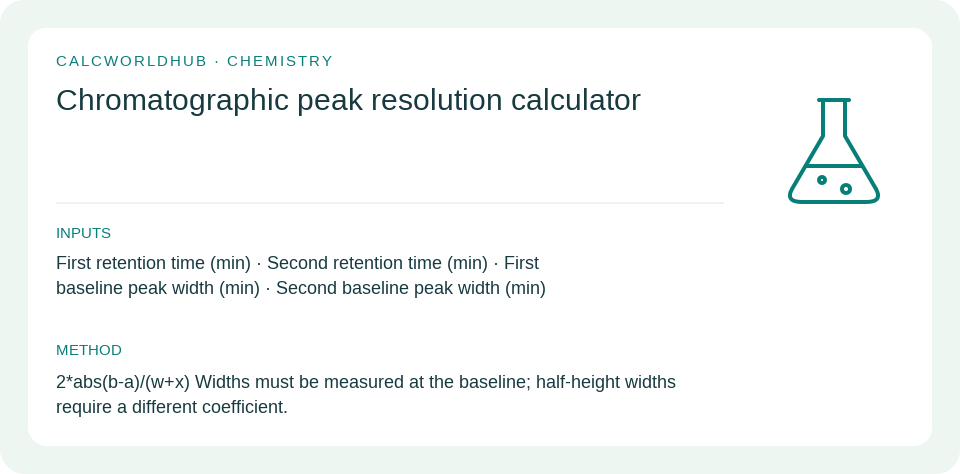
Quantify separation of two peaks using retention-time spacing and baseline widths.
- Enter First retention time (min), Second retention time (min), First baseline peak width (min), Second baseline peak width (min). Match the units shown beside each field and review the result together with the assumptions below.
- Read the worked example below to check the expected input format and result.
- Compare another scenario by changing one input at a time. Use Reset to return to the starting values.
Chromatographic peak resolution explained
How the calculation works
2*abs(b-a)/(w+x)
Widths must be measured at the baseline; half-height widths require a different coefficient.
Set up the calculation
a— First retention time (min)- Retention time from injection to the first peak apex, in minutes.
b— Second retention time (min)- Retention time from injection to the second peak apex, in minutes; it should follow the first peak for the stated ordering.
w— First baseline peak width (min)- Width of the first peak measured at its baseline, in minutes.
x— Second baseline peak width (min)- Width of the second peak measured at its baseline, in minutes. The formula is not for half-height widths.
Limits of this model
Widths must be measured at the baseline; half-height widths require a different coefficient.
Check this example
First retention time (min) = 4; Second retention time (min) = 4.6; First baseline peak width (min) = 0.3; Second baseline peak width (min) = 0.4.
- Chromatographic peak resolution: 1.714286
Reading the outputs
A larger resolution means the peak centers are farther apart relative to their baseline widths. It is a separation index; whether two peaks are adequately resolved also depends on the method and the decision threshold used in the lab.
Frequently asked questions
Can I enter half-height widths?
No, this form is for baseline widths.
Does resolution prove chemical identity?
No.
Does peak order matter?
The absolute time difference is used.
How do I use the Chromatographic peak resolution calculator?
Enter First retention time (min), Second retention time (min), First baseline peak width (min), Second baseline peak width (min). Match the units shown beside each field and review the result together with the assumptions below.
What is a worked example of Chromatographic peak resolution?
First retention time (min) = 4; Second retention time (min) = 4.6; First baseline peak width (min) = 0.3; Second baseline peak width (min) = 0.4. Chromatographic peak resolution: 1.714286
Read our calculation methodology.