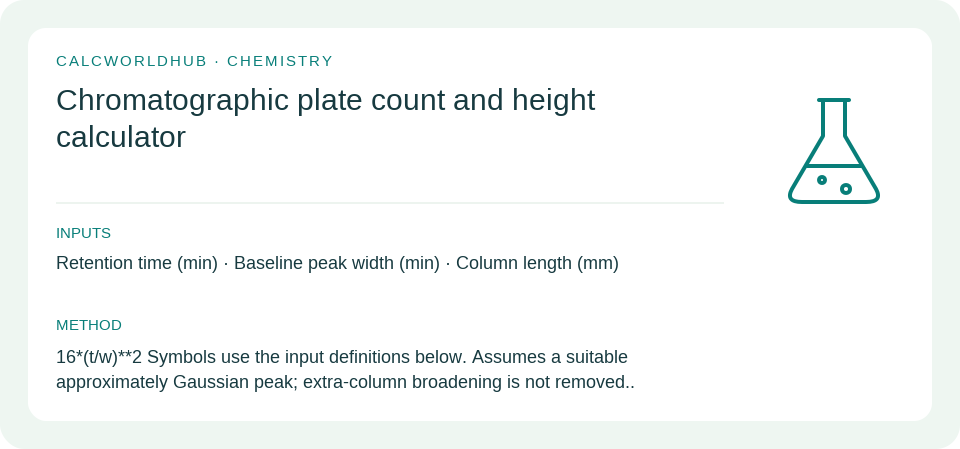
How to use this calculator
Estimate theoretical plate count and height equivalent to a theoretical plate from a baseline peak width.
- Enter Retention time (min), Baseline peak width (min), Column length (mm). Match the units shown beside each field and review the result together with the assumptions below.
- Read the worked example below to check the expected input format and result.
- Compare another scenario by changing one input at a time. Use Reset to return to the starting values.
Chromatographic plate count and height explained
Estimate a single peak’s theoretical plate count from retention time and baseline width, then derive plate height from column length.
A numerical walkthrough
Retention time (min) = 5; Baseline peak width (min) = 0.5; Column length (mm) = 150.
- Theoretical plates: 1600
- Plate height: 0.09375 mm
For this baseline-width example, N = 1600 is dimensionless and H = L/N = 150/1600 = 0.09375 mm. Compare plate height only with the same width convention and comparable extra-column broadening.
The model behind the numbers
16*(t/w)**2
Symbols use the input definitions below. Assumes a suitable approximately Gaussian peak; extra-column broadening is not removed..
What to enter
t— Retention time (min)- Retention time (min).
w— Baseline peak width (min)- Baseline peak width (min).
l— Column length (mm)- Column length (mm).
Interpreting the result
Assumes a suitable approximately Gaussian peak; extra-column broadening is not removed.
Frequently asked questions
Can I use half-height width?
Not with the baseline-width factor 16.
Is lower plate height better?
For comparable conditions, it indicates greater efficiency per column length.
Is this peak resolution?
No, it describes one peak.
How do I use the Chromatographic plate count and height calculator?
Enter Retention time (min), Baseline peak width (min), Column length (mm). Match the units shown beside each field and review the result together with the assumptions below.
What is a worked example of Chromatographic plate count and height?
Retention time (min) = 5; Baseline peak width (min) = 0.5; Column length (mm) = 150. Theoretical plates: 1600 Plate height: 0.09375 mm For this baseline-width example, N = 1600 is dimensionless and H = L/N = 150/1600 = 0.09375 mm. Compare plate height only with the same width convention and comparable extra-column broadening.
Read our calculation methodology.