How to use this calculator
Estimate heat loss from a long cylindrical member with flow crossing its axis using a documented external-flow correlation.
- Enter Unobstructed crossflow speed (m/s), Cylinder outside diameter (m), Exposed cylinder length (m), Fluid kinematic viscosity (m²/s), then complete the remaining labeled fields. Match the units shown beside each field and review the result together with the assumptions below.
- Read the worked example below to check the expected input format and result.
- Compare another scenario by changing one input at a time. Use Reset to return to the starting values.
Churchill Bernstein cylinder crossflow convection explained
Estimate average forced-convection heat transfer from an isolated cylinder in crossflow using the Churchill–Bernstein correlation.
How the calculation works
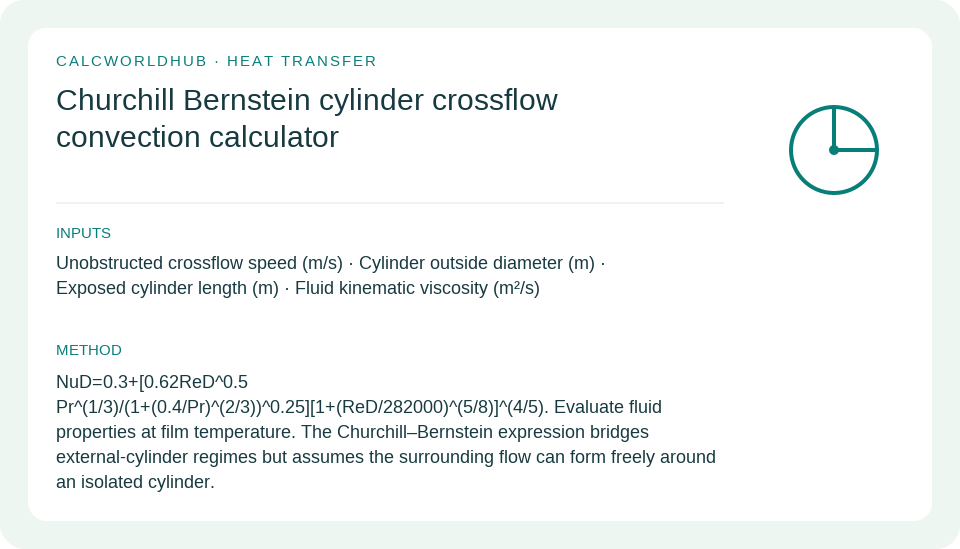
NuD=0.3+[0.62ReD^0.5 Pr^(1/3)/(1+(0.4/Pr)^(2/3))^0.25][1+(ReD/282000)^(5/8)]^(4/5).
Evaluate fluid properties at film temperature. The Churchill–Bernstein expression bridges external-cylinder regimes but assumes the surrounding flow can form freely around an isolated cylinder.
Inputs and units
U— Unobstructed crossflow speed (m/s)- Unobstructed crossflow speed (m/s). Enter the value for this state; the units shown are used without an unstated conversion.
D— Cylinder outside diameter (m)- Cylinder outside diameter (m). Enter the value for this state; the units shown are used without an unstated conversion.
L— Exposed cylinder length (m)- Exposed cylinder length (m). Enter the value for this state; the units shown are used without an unstated conversion.
nu— Fluid kinematic viscosity (m²/s)- Fluid kinematic viscosity (m²/s). Enter the value for this state; the units shown are used without an unstated conversion.
Pr— Fluid Prandtl number- Fluid Prandtl number. Enter the value for this state; the units shown are used without an unstated conversion.
kf— Fluid conductivity (W/m/K)- Fluid conductivity (W/m/K). Enter the value for this state; the units shown are used without an unstated conversion.
Ts— Cylinder surface temperature (°C)- Cylinder surface temperature (°C). Enter the value for this state; the units shown are used without an unstated conversion.
Ta— Free-stream temperature (°C)- Free-stream temperature (°C). Enter the value for this state; the units shown are used without an unstated conversion.
Limits of this model
Isolated long cylinder, negligible blockage, property gradients and buoyancy. RePr≥0.2; a correlation is an engineering estimate and does not resolve local hot spots.
Check this example
Unobstructed crossflow speed (m/s) = 4; Cylinder outside diameter (m) = 0.025; Exposed cylinder length (m) = 1; Fluid kinematic viscosity (m²/s) = 0.000016; Fluid Prandtl number = 0.71; Fluid conductivity (W/m/K) = 0.027; Cylinder surface temperature (°C) = 80; Free-stream temperature (°C) = 20.
- Average crossflow coefficient: 44.832076 W/m²/K
- Average Nusselt number: 41.511181
- Diameter Reynolds number: 6250
- Lateral surface heat rate: 211.266179 W
A 25 mm diameter, 1 m long cylinder in 4 m/s air has Reynolds number 6,250 using the supplied viscosity. Churchill–Bernstein predicts h=44.8321 W/m²/K and 211.266 W heat loss for an 80 °C surface in 20 °C air.
Reading the outputs
Average h is W/m²/K; lateral heat excludes end faces. Nu and Re use cylinder diameter.
Frequently asked questions
Can this model a tightly packed tube bank?
No. Neighboring tubes change velocity and boundary layers; tube-bank correlations are required.
Which dimension defines Reynolds number?
Outside cylinder diameter, not its exposed length.
Are the cylinder ends included?
No. The reported rate uses lateral area pi D L only.
How do I use the Churchill Bernstein cylinder crossflow convection calculator?
Enter Unobstructed crossflow speed (m/s), Cylinder outside diameter (m), Exposed cylinder length (m), Fluid kinematic viscosity (m²/s), then complete the remaining labeled fields. Match the units shown beside each field and review the result together with the assumptions below.
What is a worked example of Churchill Bernstein cylinder crossflow convection?
Unobstructed crossflow speed (m/s) = 4; Cylinder outside diameter (m) = 0.025; Exposed cylinder length (m) = 1; Fluid kinematic viscosity (m²/s) = 0.000016; Fluid Prandtl number = 0.71; Fluid conductivity (W/m/K) = 0.027; Cylinder surface temperature (°C) = 80; Free-stream temperature (°C) = 20. Average crossflow coefficient: 44.832076 W/m²/K Average Nusselt number: 41.511181 Diameter Reynolds number: 6250 Lateral surface heat rate: 211.266179 W A 25 mm diameter, 1 m long cylinder in 4 m/s air has Reynolds number 6,250 using the supplied viscosity. Churchill–Bernstein predicts h=44.8321 W/m²/K and 211.266 W heat loss for an 80 °C surface in 20 °C air.
Sources
Background or definition reference: Churchill and Bernstein original cylinder crossflow paper.
Read our calculation methodology.