How to use this calculator
Estimate buoyancy-driven heat transfer from an isolated vertical plate without supplying a guessed convection coefficient.
- Enter Vertical plate height (m), Plate width (m), Isothermal plate temperature (°C), Undisturbed fluid temperature (°C), then complete the remaining labeled fields. Match the units shown beside each field and review the result together with the assumptions below.
- Read the worked example below to check the expected input format and result.
- Compare another scenario by changing one input at a time. Use Reset to return to the starting values.
Churchill Chu vertical plate natural convection explained
Enter plate height and the surface-to-fluid temperature difference with fluid properties at film temperature; the correlation estimates average natural-convection h and one-face heat rate.
A numerical walkthrough
Vertical plate height (m) = 0.5; Plate width (m) = 0.4; Isothermal plate temperature (°C) = 60; Undisturbed fluid temperature (°C) = 20; Fluid volumetric expansion coefficient (1/K) = 0.0032; Kinematic viscosity (m²/s) = 0.000017; Fluid thermal diffusivity (m²/s) = 0.000024; Fluid conductivity (W/m/K) = 0.028.
- Average natural-convection coefficient: 5.130952 W/m²/K
- Height Rayleigh number: 384574509.803922
- Average Nusselt number: 91.624136
- One-face heat rate: 41.047613 W
A 0.5 m high by 0.4 m wide vertical plate at 60 °C stands in 20 °C air. With the entered film-state properties, Rayleigh number is 3.84575e8 and Churchill–Chu gives h=5.13095 W/m²/K, corresponding to 41.0476 W from one face.
The model behind the numbers
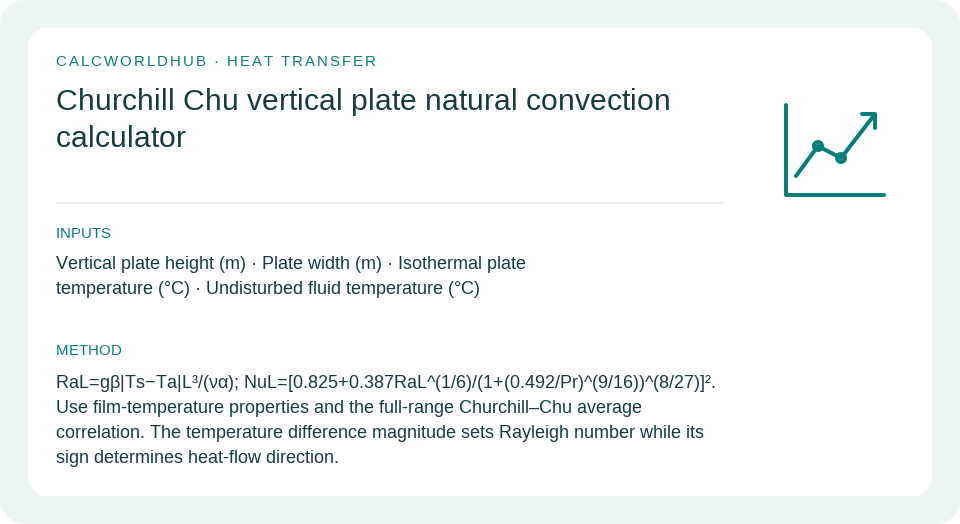
RaL=gβ|Ts−Ta|L³/(να); NuL=[0.825+0.387RaL^(1/6)/(1+(0.492/Pr)^(9/16))^(8/27)]².
Use film-temperature properties and the full-range Churchill–Chu average correlation. The temperature difference magnitude sets Rayleigh number while its sign determines heat-flow direction.
What to enter
L— Vertical plate height (m)- Vertical length used in the height-based Rayleigh and Nusselt correlations.
W— Plate width (m)- Exposed width used with height to calculate the one-face heat-transfer area; it does not change the average coefficient.
Ts— Isothermal plate temperature (°C)- Surface temperature; paired with ambient temperature to set buoyancy strength and heat-flow direction.
Ta— Undisturbed fluid temperature (°C)- Ambient fluid temperature away from the boundary layer, paired with the surface temperature.
beta— Fluid volumetric expansion coefficient (1/K)- Film-state volumetric expansion coefficient that relates temperature change to buoyant density change.
nu— Kinematic viscosity (m²/s)- Film-state momentum diffusivity used in Rayleigh and Prandtl numbers.
alpha— Fluid thermal diffusivity (m²/s)- Film-state thermal diffusivity used in Rayleigh and Prandtl numbers.
kf— Fluid conductivity (W/m/K)- Film-state conductivity used to convert average Nusselt number into h.
Interpreting the result
Vertical isothermal plate in a large quiescent fluid, Boussinesq approximation, negligible forced flow and radiation; 0.1≤Ra≤10¹².
Reading the outputs
Returns h, height-based Rayleigh number, average Nu and signed heat rate from one exposed face.
Frequently asked questions
Can a cold plate be modeled?
Yes. The heat-flow sign reverses while the correlation uses the magnitude of the temperature difference.
Why is there no zero-temperature-difference case?
At zero driving difference the empirical Rayleigh range is not met; heat transfer is zero without requiring this coefficient estimate.
Can I use plate width as L?
No. The vertical buoyant boundary-layer development length is the plate height.
How do I use the Churchill Chu vertical plate natural convection calculator?
Enter Vertical plate height (m), Plate width (m), Isothermal plate temperature (°C), Undisturbed fluid temperature (°C), then complete the remaining labeled fields. Match the units shown beside each field and review the result together with the assumptions below.
What is a worked example of Churchill Chu vertical plate natural convection?
Vertical plate height (m) = 0.5; Plate width (m) = 0.4; Isothermal plate temperature (°C) = 60; Undisturbed fluid temperature (°C) = 20; Fluid volumetric expansion coefficient (1/K) = 0.0032; Kinematic viscosity (m²/s) = 0.000017; Fluid thermal diffusivity (m²/s) = 0.000024; Fluid conductivity (W/m/K) = 0.028. Average natural-convection coefficient: 5.130952 W/m²/K Height Rayleigh number: 384574509.803922 Average Nusselt number: 91.624136 One-face heat rate: 41.047613 W A 0.5 m high by 0.4 m wide vertical plate at 60 °C stands in 20 °C air.
Background or definition reference: IIT NPTEL Churchill–Chu vertical natural convection.
Read our calculation methodology.