How to use this calculator
Estimate the geometric transit probability for a small planet on a circular orbit around a star.
- Enter Stellar radius (R☉), Orbital semi-major axis (AU). Match the units shown beside each field and review the result together with the assumptions below.
- Read the worked example below to check the expected input format and result.
- Compare another scenario by changing one input at a time. Use Reset to return to the starting values.
How this calculation works
A planet transits only when its orbital plane is aligned closely enough with the observer’s line of sight. For a circular orbit and a planet much smaller than its host star, the geometric probability is approximately the stellar radius divided by the orbital semi-major axis.
Inputs and units
stellarRadiusSolar— Stellar radius (R☉)- Radius of the host star in solar radii.
semiMajorAxisAu— Orbital semi-major axis (AU)- Semi-major axis of the planet’s circular orbit in astronomical units.
Formula
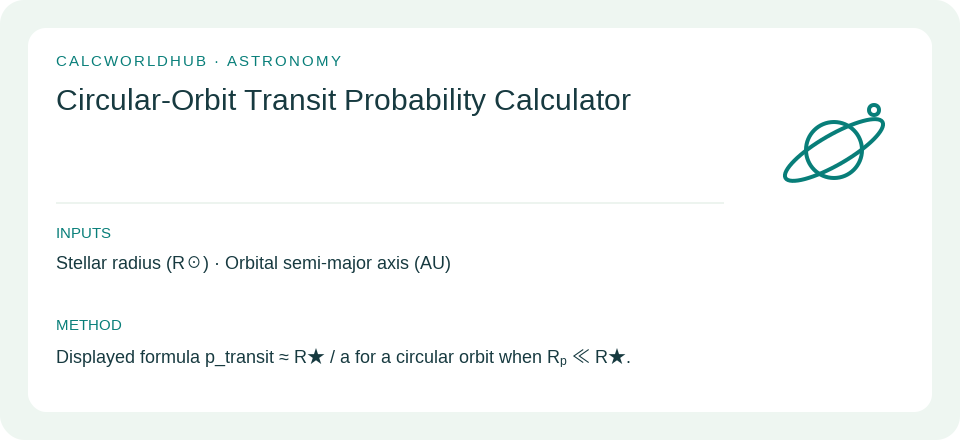
p_transit ≈ R★ / a for a circular orbit when Rₚ ≪ R★.
Method
Enter the stellar radius in solar radii and orbital semi-major axis in astronomical units. The calculator converts both to metres, then reports the approximate geometric probability, percent, and reciprocal expected alignment frequency.
Worked example
For a Sun-radius star and a circular orbit at 1 AU, p ≈ 0.004650 = 0.4650%, or about 1 favorable orientation in 215.
Assumptions and limits
This is the small-planet approximation for a circular orbit and random orbital orientation. It does not include eccentricity, a finite planet radius, detection completeness, transit depth, or the probability that a transiting planet can be detected.
Frequently asked questions
What probability does this calculate?
It estimates the chance that a randomly oriented circular orbit crosses the stellar disk from the observer’s viewpoint.
Does it predict whether a telescope will detect the planet?
No. It is only geometric; transit depth, observing cadence, noise, and survey completeness affect detectability.
Why is planet radius omitted?
The calculator uses the common small-planet approximation where the planet radius is negligible compared with the star’s radius.
How do I use the Circular-Orbit Transit Probability Calculator?
Enter Stellar radius (R☉), Orbital semi-major axis (AU). Match the units shown beside each field and review the result together with the assumptions below.
What is a worked example of Circular-Orbit Transit Probability?
For a Sun-radius star and a circular orbit at 1 AU, p ≈ 0.004650 = 0.4650%, or about 1 favorable orientation in 215.
Reference: NASA technical report transit-probability approximation for small planets on circular orbits. See our calculation methodology.