How to use this calculator
Calculate average and peak clarifier surface loading from wastewater flow, active area, and an entered peak factor.
- Enter Average wastewater flow (m³/day), Active clarifier surface area (m²), Peak-to-average flow factor. Match the units shown beside each field and review the result together with the assumptions below.
- Read the worked example below to check the expected input format and result.
- Compare another scenario by changing one input at a time. Use Reset to return to the starting values.
How this calculation works
Surface overflow rate is wastewater flow divided by a clarifier’s active plan area. Comparing average and peak hydraulic loading helps engineers organize operating observations against the unit’s own design basis; the rate alone does not describe solids flux or sludge-blanket behavior.
Inputs and units
averageFlow— Average wastewater flow (m³/day)- Average flow directed to this clarifier or equally shared active unit group.
activeArea— Active clarifier surface area (m²)- Effective plan area available for clarification; this must be greater than zero.
peakFactor— Peak-to-average flow factor- Ratio used to estimate peak flow from average flow. Use 1 when no peak adjustment is needed.
Formula
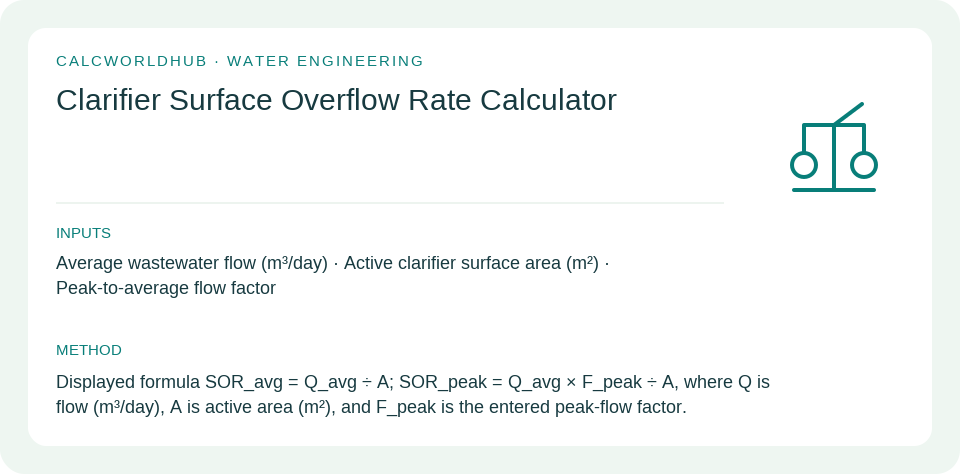
SOR_avg = Q_avg ÷ A; SOR_peak = Q_avg × F_peak ÷ A, where Q is flow (m³/day), A is active area (m²), and F_peak is the entered peak-flow factor.
Method
Divide average daily flow by the active clarifier surface area. Multiply the average flow by the entered peak factor before dividing to estimate peak loading. m³/day divided by m² gives a hydraulic loading rate in m/day.
Worked example
For 4,500 m³/day over 300 m², average surface loading is 15 m/day. With a peak factor of 2.2, estimated peak flow is 9,900 m³/day and loading is 33 m/day.
Assumptions and limits
The calculator assumes one entered active area and a peak factor applied to average flow. It does not distribute flow among units, account for solids flux, weir loading, return sludge, or establish design acceptance. Compare with applicable criteria and operating data.
Frequently asked questions
What does surface overflow rate represent?
It is flow divided by clarifier surface area and is used as a hydraulic loading measure.
Is this the same as weir overflow rate?
No. Weir overflow rate divides flow by effluent-weir length, not clarifier surface area.
What area should I enter for multiple units?
Use the active area associated with the entered flow, on a consistent per-unit or combined basis.
Does the result confirm a design is adequate?
No. Solids loading, settling, peak patterns, geometry, and applicable design criteria also matter.
How do I use the Clarifier Surface Overflow Rate Calculator?
Enter Average wastewater flow (m³/day), Active clarifier surface area (m²), Peak-to-average flow factor. Match the units shown beside each field and review the result together with the assumptions below.
Reference: U.S. EPA wastewater design manual discussing clarifier surface overflow loading from flow and area. See our calculation methodology.