How to use this calculator
Combine a measured settling-velocity distribution into an ideal clarification efficiency and solids mass balance.
- Enter Particle settling velocities (m/hour), Inlet mass fractions, Clarifier flow rate (m³/hour), Effective plan settling area (m²), then complete the remaining labeled fields. Match the units shown beside each field and review the result together with the assumptions below.
- Read the worked example below to check the expected input format and result.
- Compare another scenario by changing one input at a time. Use Reset to return to the starting values.
Ideal clarifier capture from settling velocity classes explained
The ideal settling model compares each particle class velocity with the surface-overflow rate Q/A. Each class is fully captured above that rate and proportionally captured below it; the inlet mass fractions weight the total.
Inputs, symbols, and units
v— Particle settling velocities (m/hour)- Positive terminal settling speeds for discrete particle classes. Use comma-separated values in the stated order.
f— Inlet mass fractions- Nonnegative matching mass fractions; they must sum to one. Use comma-separated values in the stated order.
Q— Clarifier flow rate (m³/hour)- Water flow crossing the ideal horizontal settling basin.
A— Effective plan settling area (m²)- Horizontal plan area used for surface overflow rate.
C— Inlet suspended solids (mg/L)- Concentration of the represented settling particle classes.
Formula and method
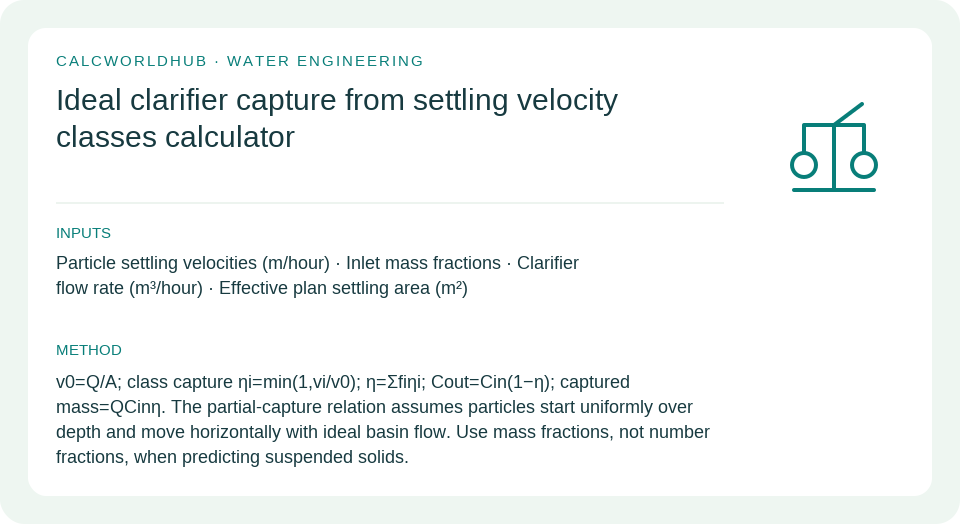
v0=Q/A; class capture ηi=min(1,vi/v0); η=Σfiηi; Cout=Cin(1−η); captured mass=QCinη.
The partial-capture relation assumes particles start uniformly over depth and move horizontally with ideal basin flow. Use mass fractions, not number fractions, when predicting suspended solids.
A worked scenario
Particle settling velocities (m/hour) = [0.2, 0.6, 1.5, 3]; Inlet mass fractions = [0.2, 0.3, 0.3, 0.2]; Clarifier flow rate (m³/hour) = 500; Effective plan settling area (m²) = 400; Inlet suspended solids (mg/L) = 100.
- Ideal total solids capture: 67.6 %
- Predicted effluent suspended solids: 32.4 mg/L
- Captured dry solids rate: 33.8 kg/hour
- Surface overflow rate: 1.25 m/hour
A 500 m³/h clarifier has 400 m² plan area. Four mass classes settle at 0.2, 0.6, 1.5 and 3 m/h with fractions 0.2, 0.3, 0.3 and 0.2.
Assumptions and edge cases
Ideal discrete settling only. Flocculation, hindered settling, short-circuiting, inlet turbulence and density currents can reduce or alter real performance. Educational model; this is not a code-compliant design check.
Reading the outputs
Capture is percent, effluent concentration is mg/L, captured solids are kg/h and overflow velocity is m/h.
Frequently asked questions
Why use plan area instead of depth?
Under ideal discrete settling, both settling time and throughflow time scale with depth, leaving the surface overflow rate as the controlling ratio.
Can mass fractions sum to less than one?
No. Include the whole represented solids distribution or normalize appropriately before entry.
Does 100% ideal capture guarantee clean effluent?
No. Nonsettling material and real hydraulic defects are outside this ideal class model.
How do I use the Ideal clarifier capture from settling velocity classes calculator?
Enter Particle settling velocities (m/hour), Inlet mass fractions, Clarifier flow rate (m³/hour), Effective plan settling area (m²), then complete the remaining labeled fields. Match the units shown beside each field and review the result together with the assumptions below.
What is a worked example of Ideal clarifier capture from settling velocity classes?
Particle settling velocities (m/hour) = [0.2, 0.6, 1.5, 3]; Inlet mass fractions = [0.2, 0.3, 0.3, 0.2]; Clarifier flow rate (m³/hour) = 500; Effective plan settling area (m²) = 400; Inlet suspended solids (mg/L) = 100. Ideal total solids capture: 67.6 % Predicted effluent suspended solids: 32.4 mg/L Captured dry solids rate: 33.8 kg/hour Surface overflow rate: 1.25 m/hour A 500 m³/h clarifier has 400 m² plan area. Four mass classes settle at 0.2, 0.6, 1.5 and 3 m/h with fractions 0.2, 0.3, 0.3 and 0.2.
Read our calculation methodology.