How to use this calculator
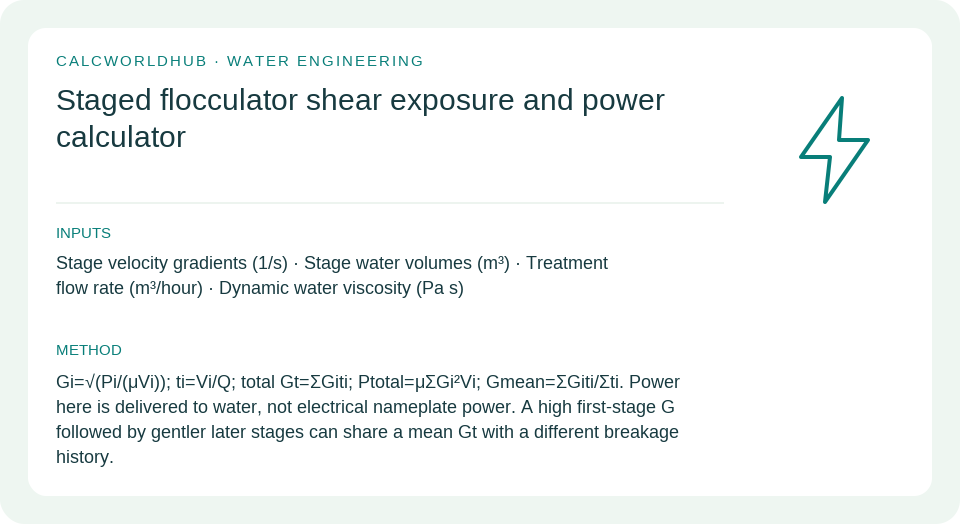
Compare tapered flocculation stages through total shear exposure, water-phase power and contact time while keeping every stage explicit.
- Enter Stage velocity gradients (1/s), Stage water volumes (m³), Treatment flow rate (m³/hour), Dynamic water viscosity (Pa s). Match the units shown beside each field and review the result together with the assumptions below.
- Read the worked example below to check the expected input format and result.
- Compare another scenario by changing one input at a time. Use Reset to return to the starting values.
Staged flocculator shear exposure and power explained
Compare tapered flocculation stages through total shear exposure, water-phase power and contact time while keeping every stage explicit.
How the calculation works
Gi=√(Pi/(μVi)); ti=Vi/Q; total Gt=ΣGiti; Ptotal=μΣGi²Vi; Gmean=ΣGiti/Σti.
Power here is delivered to water, not electrical nameplate power. A high first-stage G followed by gentler later stages can share a mean Gt with a different breakage history.
Set up the calculation
G— Stage velocity gradients (1/s)- Average water-phase velocity gradient in each sequential flocculation stage. Use comma-separated values in the stated order.
V— Stage water volumes (m³)- Active mixed volume of each stage. Use comma-separated values in the stated order.
Q— Treatment flow rate (m³/hour)- Flow passing through every stage in series.
mu— Dynamic water viscosity (Pa s)- Absolute viscosity at operating water temperature.
Limits of this model
Mean gradient and nominal plug-through stage contact only; actual floc growth, breakup, chemistry and residence-time distribution are not predicted. Educational model; this is not a code-compliant design check.
Check this example
Stage velocity gradients (1/s) = [60, 40, 25]; Stage water volumes (m³) = [50, 50, 50]; Treatment flow rate (m³/hour) = 300; Dynamic water viscosity (Pa s) = 0.001.
- Total flocculation Gt exposure: 75000
- Total water-phase mixing power: 291.25 W
- Hydraulic contact time: 30 minutes
- Time-weighted mean gradient: 41.666667 1/s
Three 50 m³ stages operate at 60, 40 and 25 s⁻¹ with 300 m³/h flow. Each has ten minutes nominal contact, and the combined Gt is 75,000.
Reading the outputs
Gt is dimensionless, water-phase power is W, contact time is minutes and mean gradient is s⁻¹.
Comparison scenario
If flow doubles from 300 to 600 m³/hour while stage volumes and gradients stay fixed, each 50 m³ stage residence time falls from 600 s to 300 s. Total Gt therefore falls from 75,000 to 37,500, while the ideal water-phase mixing power stays 291.25 W because μ, G and V did not change.
Frequently asked questions
Is the mean G enough to describe a tapered basin?
No. Different stage sequences can have the same mean while exposing fragile flocs to different late-stage shear.
Can motor input be substituted for water-phase power?
Only after accounting for drivetrain and impeller transfer efficiency.
Does a larger Gt guarantee better clarification?
No. Excessive shear can break flocs, and coagulation chemistry must first be suitable.
How do I use the Staged flocculator shear exposure and power calculator?
Enter Stage velocity gradients (1/s), Stage water volumes (m³), Treatment flow rate (m³/hour), Dynamic water viscosity (Pa s). Match the units shown beside each field and review the result together with the assumptions below.
What is a worked example of Staged flocculator shear exposure and power?
Stage velocity gradients (1/s) = [60, 40, 25]; Stage water volumes (m³) = [50, 50, 50]; Treatment flow rate (m³/hour) = 300; Dynamic water viscosity (Pa s) = 0.001. Total flocculation Gt exposure: 75000 Total water-phase mixing power: 291.25 W Hydraulic contact time: 30 minutes Time-weighted mean gradient: 41.666667 1/s Three 50 m³ stages operate at 60, 40 and 25 s⁻¹ with 300 m³/h flow. Each has ten minutes nominal contact, and the combined Gt is 75,000.
Background or definition reference: EPA Nutrient Control Design Manual, mixing intensity equation.
Read our calculation methodology.