How to use this calculator
Estimate terminal rise or settling speed for a small isolated rigid sphere and check the creeping-flow condition.
- Enter Particle diameter (µm), Particle density (kg/m³), Fluid density (kg/m³), Fluid dynamic viscosity (Pa·s), then complete the remaining labeled fields. Match the units shown beside each field and review the result together with the assumptions below.
- Read the worked example below to check the expected input format and result.
- Compare another scenario by changing one input at a time. Use Reset to return to the starting values.
Creeping flow spherical particle settling explained
Stokes settling balances the sphere’s density-difference weight against linear viscous drag. Diameter is converted from micrometres to metres; the signed density difference distinguishes settling from rising, and the result is retained only when particle Reynolds number is below the stated creeping-flow threshold.
Inputs, symbols, and units
d— Particle diameter (µm)- Particle diameter (µm).
rp— Particle density (kg/m³)- Particle density (kg/m³).
rf— Fluid density (kg/m³)- Fluid density (kg/m³).
mu— Fluid dynamic viscosity (Pa·s)- Fluid dynamic viscosity (Pa·s).
g— Gravity (m/s²)- Gravity (m/s²).
Formula and method
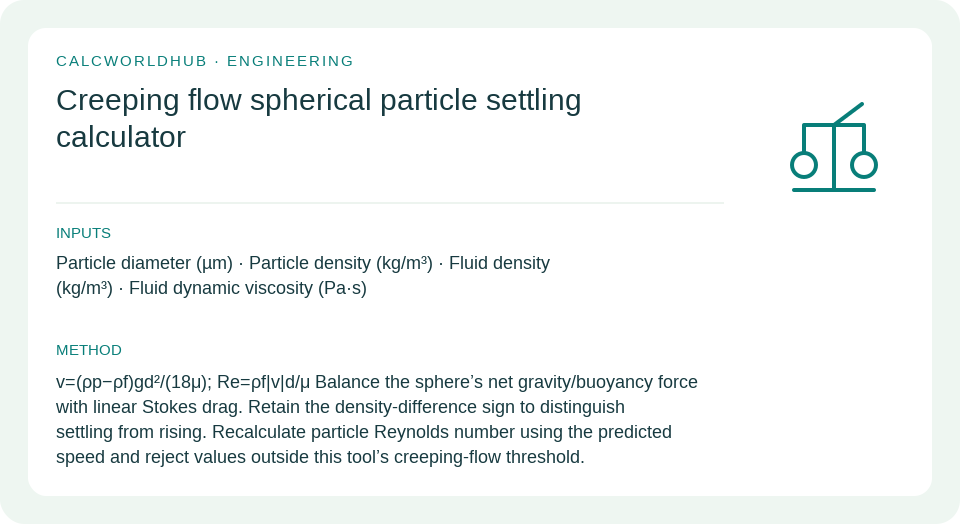
v=(ρp−ρf)gd²/(18μ); Re=ρf|v|d/μ
Balance the sphere’s net gravity/buoyancy force with linear Stokes drag. Retain the density-difference sign to distinguish settling from rising. Recalculate particle Reynolds number using the predicted speed and reject values outside this tool’s creeping-flow threshold.
A worked scenario
Particle diameter (µm) = 30; Particle density (kg/m³) = 2650; Fluid density (kg/m³) = 1000; Fluid dynamic viscosity (Pa·s) = 0.001; Gravity (m/s²) = 9.80665.
- Signed terminal settling velocity: 0.0008090486 m/s
- Particle Reynolds number: 0.02427146
This scenario uses the stated units and assumptions. Displayed values are rounded only after calculation.
Assumptions and edge cases
This tool requires calculated particle Reynolds number below 0.1. No wall, concentration, nonsphericity, or Brownian effects are included.
Frequently asked questions
Can the velocity be negative?
Yes, a particle less dense than the fluid rises under this signed convention.
Why reject larger Reynolds number?
Stokes drag is no longer the intended approximation.
Does it handle a concentrated suspension?
No.
How do I use the Creeping flow spherical particle settling calculator?
Enter Particle diameter (µm), Particle density (kg/m³), Fluid density (kg/m³), Fluid dynamic viscosity (Pa·s), then complete the remaining labeled fields. Match the units shown beside each field and review the result together with the assumptions below.
What is a worked example of Creeping flow spherical particle settling?
Particle diameter (µm) = 30; Particle density (kg/m³) = 2650; Fluid density (kg/m³) = 1000; Fluid dynamic viscosity (Pa·s) = 0.001; Gravity (m/s²) = 9.80665. Signed terminal settling velocity: 0.0008090486 m/s Particle Reynolds number: 0.02427146 This scenario uses the stated units and assumptions. Displayed values are rounded only after calculation.
Read our calculation methodology.