How to use this calculator
Combine viscous and inertial packed-bed pressure losses for a homogeneous porous bed.
- Enter Packed-bed length (m), Effective particle diameter (mm), Bed void fraction, Superficial velocity (m/s), then complete the remaining labeled fields. Match the units shown beside each field and review the result together with the assumptions below.
- Read the worked example below to check the expected input format and result.
- Compare another scenario by changing one input at a time. Use Reset to return to the starting values.
Packed bed Ergun pressure drop explained
A numerical walkthrough
Packed-bed length (m) = 1; Effective particle diameter (mm) = 3; Bed void fraction = 0.4; Superficial velocity (m/s) = 0.05; Dynamic viscosity (Pa·s) = 0.001; Fluid density (kg/m³) = 1000.
- Packed-bed pressure drop: 18359.375 Pa
- Viscous contribution: 4687.5 Pa
- Inertial contribution: 13671.875 Pa
The model behind the numbers
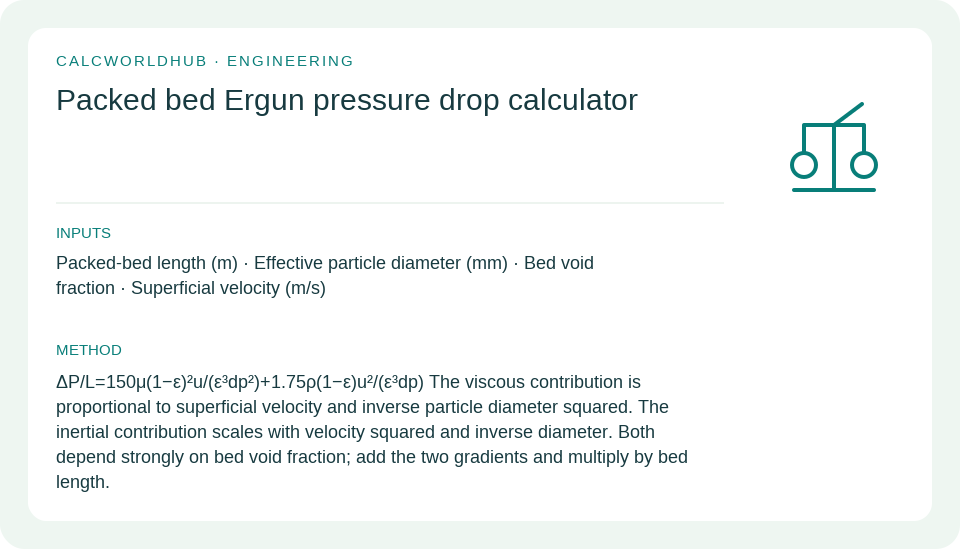
ΔP/L=150μ(1−ε)²u/(ε³dp²)+1.75ρ(1−ε)u²/(ε³dp)
The viscous contribution is proportional to superficial velocity and inverse particle diameter squared. The inertial contribution scales with velocity squared and inverse diameter. Both depend strongly on bed void fraction; add the two gradients and multiply by bed length.
What to enter
l— Packed-bed length (m)- Packed-bed length (m).
d— Effective particle diameter (mm)- Effective particle diameter (mm).
e— Bed void fraction- Bed void fraction.
u— Superficial velocity (m/s)- Superficial velocity (m/s).
mu— Dynamic viscosity (Pa·s)- Dynamic viscosity (Pa·s).
rho— Fluid density (kg/m³)- Fluid density (kg/m³).
Interpreting the result
Superficial velocity is based on empty column area. Uniform effective particles and void fraction; wall effects, compressibility, fluidization, and fouling are excluded.
Frequently asked questions
Is interstitial velocity the input?
No, use superficial flow velocity.
Does particle shape matter?
Yes, an appropriate effective diameter and model applicability are needed.
Can this predict fluidization?
No, compare against a separate force balance.
How do I use the Packed bed Ergun pressure drop calculator?
Enter Packed-bed length (m), Effective particle diameter (mm), Bed void fraction, Superficial velocity (m/s), then complete the remaining labeled fields. Match the units shown beside each field and review the result together with the assumptions below.
What is a worked example of Packed bed Ergun pressure drop?
Packed-bed length (m) = 1; Effective particle diameter (mm) = 3; Bed void fraction = 0.4; Superficial velocity (m/s) = 0.05; Dynamic viscosity (Pa·s) = 0.001; Fluid density (kg/m³) = 1000. Packed-bed pressure drop: 18359.375 Pa Viscous contribution: 4687.5 Pa Inertial contribution: 13671.875 Pa
Method reference: University of Michigan packed-bed pressure-drop notes.
Read our calculation methodology.