How to use this calculator
Calculate coarse-aggregate bulk and apparent specific gravity and water absorption from oven-dry, saturated-surface-dry, and submerged sample masses.
- Enter Oven-dry aggregate mass in air, A (g), SSD aggregate mass in air, B (g), SSD aggregate mass submerged, C (g). Match the units shown beside each field and review the result together with the assumptions below.
- Read the worked example below to check the expected input format and result.
- Compare another scenario by changing one input at a time. Use Reset to return to the starting values.
How this calculation works
Enter the oven-dry mass in air, the saturated-surface-dry (SSD) mass in air, and the SSD mass while submerged. Keep all three measurements in the same mass unit. The outputs are relative-density ratios and absorption by dry mass.
Inputs and units
ovenDryMassG— Oven-dry aggregate mass in air, A (g)- Mass after oven drying and cooling, measured in air.
ssdMassG— SSD aggregate mass in air, B (g)- Saturated-surface-dry mass measured in air.
submergedMassG— SSD aggregate mass submerged, C (g)- Apparent mass of the SSD sample while submerged in water.
Formula
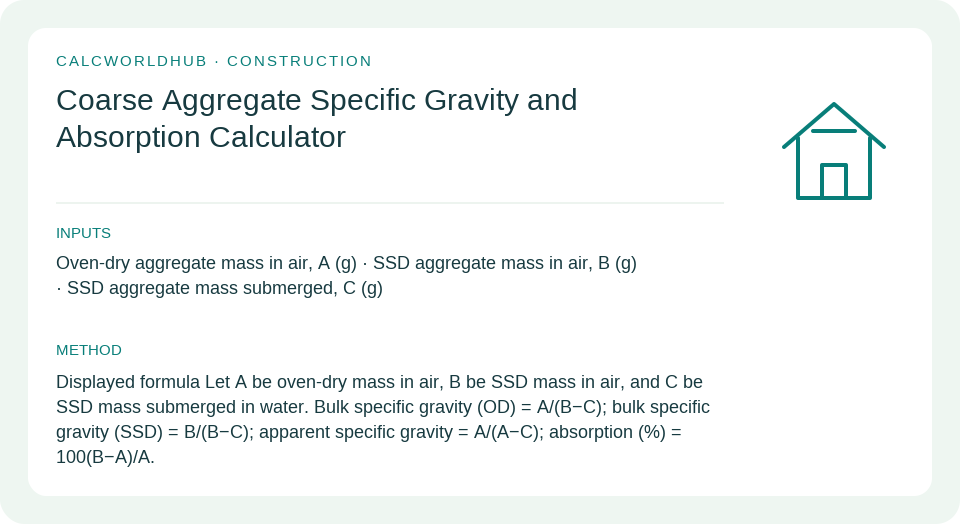
Let A be oven-dry mass in air, B be SSD mass in air, and C be SSD mass submerged in water. Bulk specific gravity (OD) = A/(B−C); bulk specific gravity (SSD) = B/(B−C); apparent specific gravity = A/(A−C); absorption (%) = 100(B−A)/A.
Method
The submerged SSD mass is used with the in-air SSD mass to estimate the sample's bulk volume by water displacement. The dry and SSD masses then give oven-dry bulk and SSD bulk relative density; excluding permeable voids gives apparent relative density. Absorption is the water mass gained divided by oven-dry mass.
Worked example
For A = 480 g, B = 500 g, and C = 300 g, the bulk specific gravity is 2.4000 on an oven-dry basis and 2.5000 on an SSD basis, the apparent specific gravity is 2.6667, and absorption is 4.167%.
Assumptions and limits
This reduces measured ASTM C127-style coarse-aggregate test masses; it does not replace sample conditioning, SSD endpoint judgment, equipment checks, or the standard test procedure. Use the same mass units for A, B, and C. It is not intended for lightweight aggregate or fine aggregate measured by the separate pycnometer procedure.
Frequently asked questions
What does C represent?
C is the measured mass of the SSD coarse-aggregate sample while it is submerged in water, after applying the test procedure's suspension and weighing corrections.
Why are there three specific-gravity results?
The oven-dry and SSD bulk values use the sample's bulk volume including permeable pores; apparent specific gravity excludes those permeable pores.
Can I use any mass unit?
Yes, as long as A, B, and C use the same unit. The ratios and absorption percentage are unitless.
How do I use the Coarse Aggregate Specific Gravity and Absorption Calculator?
Enter Oven-dry aggregate mass in air, A (g), SSD aggregate mass in air, B (g), SSD aggregate mass submerged, C (g). Match the units shown beside each field and review the result together with the assumptions below.
What is a worked example of Coarse Aggregate Specific Gravity and Absorption?
For A = 480 g, B = 500 g, and C = 300 g, the bulk specific gravity is 2.4000 on an oven-dry basis and 2.5000 on an SSD basis, the apparent specific gravity is 2.6667, and absorption is 4.167%.
Reference: technical reference. See our calculation methodology.