How to use this calculator
Estimate coating mass delivered and material supplied for a target dry-film thickness over a surface.
- Enter Coated surface area (m²), Dry film thickness (µm), Dry coating density (kg/L), Volume solids (%), then complete the remaining labeled fields. Match the units shown beside each field and review the result together with the assumptions below.
- Read the worked example below to check the expected input format and result.
- Compare another scenario by changing one input at a time. Use Reset to return to the starting values.
Coating material mass from surface area film thickness and transfer efficiency explained
Dry-film volume follows coated area and target thickness; density converts that volume to deposited mass. The wet supply estimate increases as coating solids or spray transfer efficiency decreases.
Inputs, symbols, and units
area— Coated surface area (m²)- Total area receiving the uniform coating.
thick— Dry film thickness (µm)- Specified dry coating thickness after curing.
density— Dry coating density (kg/L)- Density of cured coating solids.
solids— Volume solids (%)- Fraction of wet coating volume that remains as dry film.
transfer— Transfer efficiency (%)- Fraction of sprayed coating solids deposited on the part.
Formula and method
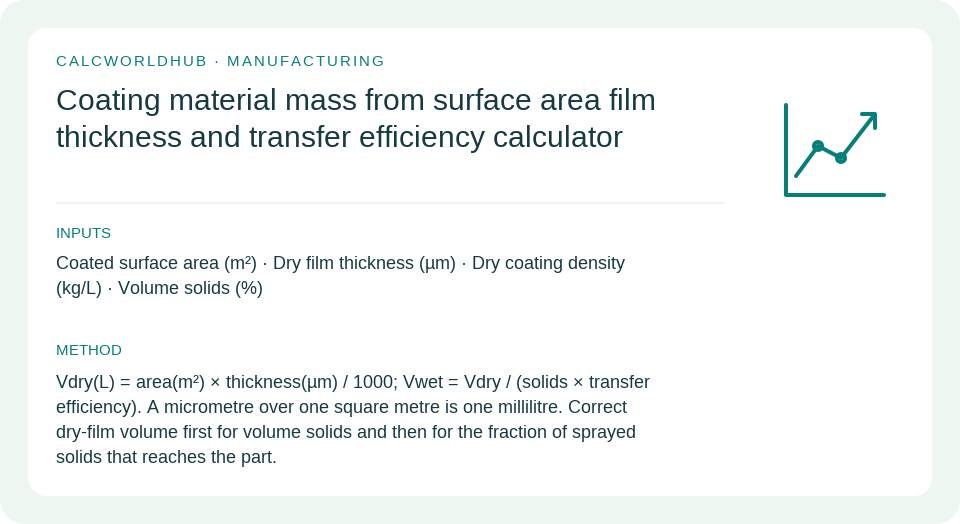
Vdry(L) = area(m²) × thickness(µm) / 1000; Vwet = Vdry / (solids × transfer efficiency).
A micrometre over one square metre is one millilitre. Correct dry-film volume first for volume solids and then for the fraction of sprayed solids that reaches the part.
A worked scenario
Coated surface area (m²) = 85; Dry film thickness (µm) = 60; Dry coating density (kg/L) = 1.25; Volume solids (%) = 58; Transfer efficiency (%) = 72.
- Dry film volume: 5.1 L
- Deposited dry coating mass: 6.375 kg
- Wet coating supply estimate: 12.212644 L
For 85 m² at 60 µm, the dry film occupies 5.1 L. At 58% volume solids and 72% transfer efficiency, wet supply is about 12.2 L.
Assumptions and edge cases
Uniform film and a single pass are assumed. Viscosity, overspray recovery, solvent loss, multiple coats, and manufacturer coverage conventions can change purchasing needs.
Reading the outputs
The main result is wet coating supply in litres; supporting outputs are labeled with their own units. Use the units shown beside each input and result.
Frequently asked questions
What does the coating material mass from surface area film thickness and transfer efficiency calculate?
For 85 m² at 60 µm, the dry film occupies 5.1 L. At 58% volume solids and 72% transfer efficiency, wet supply is about 12.2 L.
Which inputs most affect wet coating supply in litres?
A micrometre over one square metre is one millilitre. Correct dry-film volume first for volume solids and then for the fraction of sprayed solids that reaches the part.
Can this result replace a site-specific or measured value?
Uniform film and a single pass are assumed. Viscosity, overspray recovery, solvent loss, multiple coats, and manufacturer coverage conventions can change purchasing needs.
How do I use the Coating material mass from surface area film thickness and transfer efficiency calculator?
Enter Coated surface area (m²), Dry film thickness (µm), Dry coating density (kg/L), Volume solids (%), then complete the remaining labeled fields. Match the units shown beside each field and review the result together with the assumptions below.
What is a worked example of Coating material mass from surface area film thickness and transfer efficiency?
Coated surface area (m²) = 85; Dry film thickness (µm) = 60; Dry coating density (kg/L) = 1.25; Volume solids (%) = 58; Transfer efficiency (%) = 72. Dry film volume: 5.1 L Deposited dry coating mass: 6.375 kg Wet coating supply estimate: 12.212644 L For 85 m² at 60 µm, the dry film occupies 5.1 L. At 58% volume solids and 72% transfer efficiency, wet supply is about 12.2 L.
Read our calculation methodology.