How to use this calculator
Estimate output, marginal products, and returns to scale from a two-input Cobb-Douglas production function.
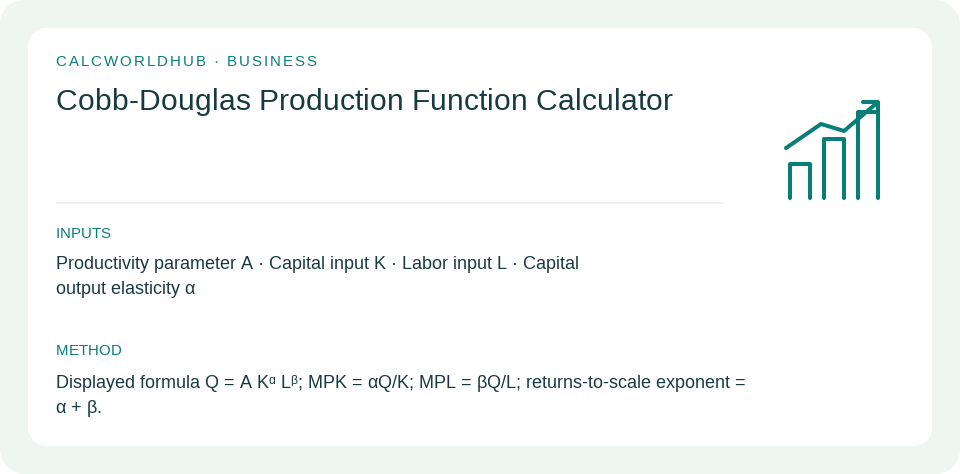
- Enter Productivity parameter A, Capital input K, Labor input L, Capital output elasticity α, then complete the remaining labeled fields. Match the units shown beside each field and review the result together with the assumptions below.
- Read the worked example below to check the expected input format and result.
- Compare another scenario by changing one input at a time. Use Reset to return to the starting values.
How this calculation works
The two-input Cobb-Douglas form models output as productivity multiplied by capital raised to its output elasticity and labor raised to its output elasticity. This calculator reports modeled output, the marginal product of each input, and returns to scale from the sum of the exponents. The parameters must come from a stated model or estimate; the function does not infer them from raw observations.
Inputs and units
productivity— Productivity parameter A- Use a positive factor consistent with the model's input and output units.
capital— Capital input K- Enter a positive capital quantity using the units behind the model.
labor— Labor input L- Enter a positive labor quantity using the units behind the model.
alpha— Capital output elasticity α- Enter a nonnegative estimated exponent for capital.
beta— Labor output elasticity β- Enter a nonnegative estimated exponent for labor.
Formula
Q = A Kᵅ Lᵝ; MPK = αQ/K; MPL = βQ/L; returns-to-scale exponent = α + β.
Method
Enter positive productivity A, capital K, and labor L with compatible units, plus nonnegative elasticities α and β. The sum α + β below, equal to, or above one indicates decreasing, constant, or increasing returns to scale.
Worked example
For A = 1.5, K = 100, L = 50, α = 0.30, and β = 0.60, modeled output Q = 62.4415 and α + β = 0.90, indicating decreasing returns to scale.
Assumptions and limits
This is a specified production model, not a causal forecast. Output units and valid parameter estimates depend on the application and data.
Frequently asked questions
What does the productivity parameter A represent?
A scales output for the specified input units and model; its units depend on how capital, labor, and output are measured.
How do the exponents determine returns to scale?
If α + β is below one the model has decreasing returns to scale; equal to one means constant returns; above one means increasing returns.
Does the calculator estimate the exponents from data?
No. Enter α and β from a chosen model or an estimation performed on suitable production data.
How do I use the Cobb-Douglas Production Function Calculator?
Enter Productivity parameter A, Capital input K, Labor input L, Capital output elasticity α, then complete the remaining labeled fields. Match the units shown beside each field and review the result together with the assumptions below.
What is a worked example of Cobb-Douglas Production Function?
For A = 1.5, K = 100, L = 50, α = 0.30, and β = 0.60, modeled output Q = 62.4415 and α + β = 0.90, indicating decreasing returns to scale.
Reference: technical reference. See our calculation methodology.