How to use this calculator
Estimate soil coefficient of consolidation from a laboratory t50 and the specimen drainage path.
- Enter Effective drainage path Hdr (m), Time to 50% consolidation t50 (s). Match the units shown beside each field and review the result together with the assumptions below.
- Read the worked example below to check the expected input format and result.
- Compare another scenario by changing one input at a time. Use Reset to return to the starting values.
How this calculation works
In a one-dimensional consolidation test, the time required to reach 50% primary consolidation can be combined with a theoretical time factor and drainage path to estimate the coefficient of consolidation.
Inputs and units
hdr— Effective drainage path Hdr (m)- Enter the longest drainage path; for double drainage, this is typically half the specimen thickness.
t50— Time to 50% consolidation t50 (s)- Enter elapsed seconds from the test curve to 50% primary consolidation.
Formula
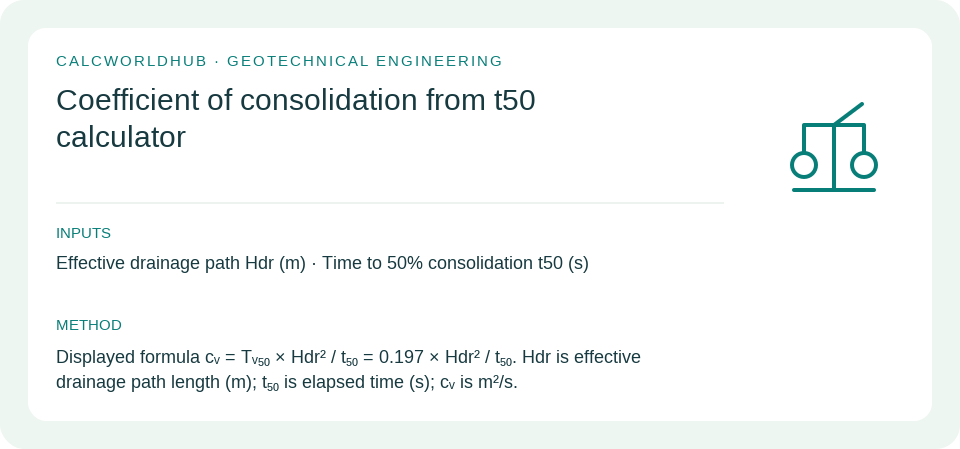
cᵥ = Tᵥ₅₀ × Hdr² / t₅₀ = 0.197 × Hdr² / t₅₀. Hdr is effective drainage path length (m); t₅₀ is elapsed time (s); cᵥ is m²/s.
Method
The time factor 0.197 corresponds to 50% average primary consolidation for the conventional one-dimensional Terzaghi solution. Enter the actual drainage path length; for a uniform specimen drained at both faces it is half the specimen thickness.
Worked example
For Hdr = 0.010 m and t50 = 120 s, cᵥ = 0.197 × 0.010² / 120 ≈ 1.642 × 10⁻⁷ m²/s, or about 0.01418 m²/day.
Assumptions and limits
This estimate relies on one-dimensional Terzaghi consolidation assumptions and a correctly interpreted t50 curve. Layering, secondary compression, nonlinear behavior, smear, and boundary effects can invalidate the simplified model. It is not a substitute for geotechnical design review.
Frequently asked questions
How do I choose Hdr?
Use the longest drainage path. In a uniform specimen draining from both faces, Hdr is half the specimen thickness; for single drainage it is the full thickness.
Why does the input use seconds?
The output unit m²/s follows directly when drainage length is in metres and elapsed time is in seconds.
Does this calculate settlement magnitude?
No. It estimates a rate parameter. Settlement magnitude requires compressibility and layer-stress information.
How do I use the Coefficient of consolidation from t50 calculator?
Enter Effective drainage path Hdr (m), Time to 50% consolidation t50 (s). Match the units shown beside each field and review the result together with the assumptions below.
What is a worked example of Coefficient of consolidation from t50?
For Hdr = 0.010 m and t50 = 120 s, cᵥ = 0.197 × 0.010² / 120 ≈ 1.642 × 10⁻⁷ m²/s, or about 0.01418 m²/day.
Reference: FHWA geotechnical guidance for coefficient of consolidation from t50. See our calculation methodology.