How to use this calculator
Estimate cooling time when forced or natural air convection acts alongside temperature-dependent radiation.
- Enter Lumped body heat capacity (J/K), Exposed area (m²), Convection coefficient (W/m²/K), Gray thermal emissivity, then complete the remaining labeled fields. Match the units shown beside each field and review the result together with the assumptions below.
- Read the worked example below to check the expected input format and result.
- Compare another scenario by changing one input at a time. Use Reset to return to the starting values.
Combined convection and radiation cooling time explained
Integrate a lumped body’s cooling time while convection to air and radiation to surrounding surfaces remove heat simultaneously.
A numerical walkthrough
Lumped body heat capacity (J/K) = 1000; Exposed area (m²) = 0.2; Convection coefficient (W/m²/K) = 10; Gray thermal emissivity = 0.8; Initial body temperature (K) = 500; Target body temperature (K) = 350; Air temperature (K) = 300; Radiant surroundings temperature (K) = 290.
- Cooling time: 369.430479 s
- Initial total heat loss: 902.868672 W
- Stored sensible energy released: 150000 J
A 1,000 J/K body of area 0.2 m² cools from 500 to 350 K with h=10 W/m²/K, emissivity 0.8, air at 300 K and radiant surroundings at 290 K. Both mechanisms together take 369.430 s; the initial loss is 902.869 W.
The model behind the numbers
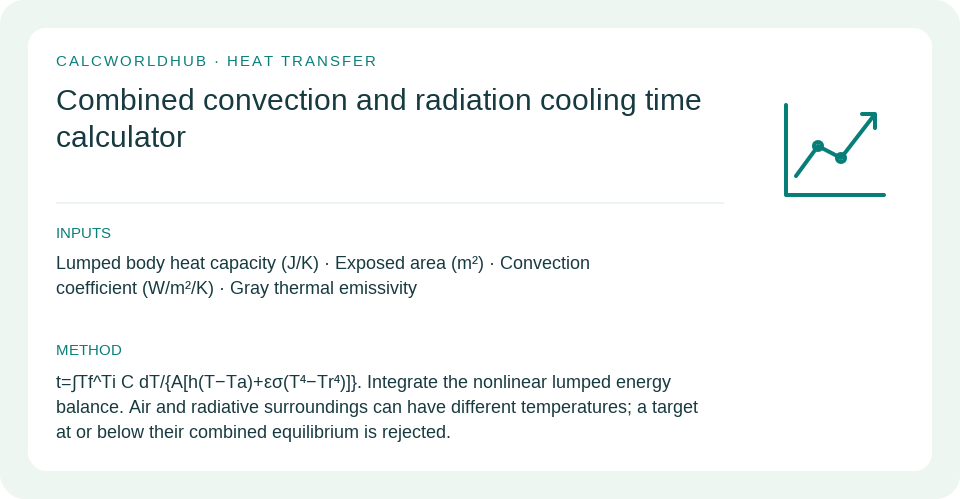
t=∫Tf^Ti C dT/{A[h(T−Ta)+εσ(T⁴−Tr⁴)]}.
Integrate the nonlinear lumped energy balance. Air and radiative surroundings can have different temperatures; a target at or below their combined equilibrium is rejected.
What to enter
C— Lumped body heat capacity (J/K)- Effective body heat capacity for the full temperature range; assumes the body can be treated as one uniform temperature.
A— Exposed area (m²)- Surface area exchanging heat with both the air and radiative surroundings.
hc— Convection coefficient (W/m²/K)- Average air-side convection coefficient, held constant through the cooling interval.
e— Gray thermal emissivity- Gray-body emissivity from 0 to 1, assumed constant with temperature.
Ti— Initial body temperature (K)- Uniform starting temperature in kelvin; it must exceed the target temperature.
Tf— Target body temperature (K)- Cooling endpoint in kelvin; it must remain above the combined thermal equilibrium for a finite cooling time.
Ta— Air temperature (K)- Air temperature that sets the convective driving difference T − Ta.
Tr— Radiant surroundings temperature (K)- Radiative-surroundings temperature that sets T⁴ − Tr⁴; it can differ from the air temperature.
Interpreting the result
Uniform body temperature, constant heat capacity, area, coefficient and emissivity. No internal generation or phase change; Simpson quadrature uses 2,000 panels in the logarithm of temperature excess above equilibrium, resolving the slow final approach.
Reading the outputs
Time is s, initial heat loss is W and released stored energy is J. The heat-loss rate falls during cooling.
Frequently asked questions
Can I add separately computed radiation and convection cooling times?
No. The rates add inside the energy balance, not the elapsed times.
Why reject a target below equilibrium?
Passive cooling cannot cross its steady thermal balance under fixed surroundings.
Can one mode be disabled?
Yes. Set either h or emissivity to zero while retaining a nonzero other loss mechanism.
How do I use the Combined convection and radiation cooling time calculator?
Enter Lumped body heat capacity (J/K), Exposed area (m²), Convection coefficient (W/m²/K), Gray thermal emissivity, then complete the remaining labeled fields. Match the units shown beside each field and review the result together with the assumptions below.
What is a worked example of Combined convection and radiation cooling time?
Lumped body heat capacity (J/K) = 1000; Exposed area (m²) = 0.2; Convection coefficient (W/m²/K) = 10; Gray thermal emissivity = 0.8; Initial body temperature (K) = 500; Target body temperature (K) = 350; Air temperature (K) = 300; Radiant surroundings temperature (K) = 290. Cooling time: 369.430479 s Initial total heat loss: 902.868672 W Stored sensible energy released: 150000 J A 1,000 J/K body of area 0.2 m² cools from 500 to 350 K with h=10 W/m²/K, emissivity 0.8, air at 300 K and radiant surroundings at 290 K. Both mechanisms together take 369.430 s; the initial loss is 902.869 W.
Read our calculation methodology.