How to use this calculator
Combine independent standard uncertainty components by root-sum-square and apply a coverage factor.
- Enter Standard uncertainty components (same units), Coverage factor k. Match the units shown beside each field and review the result together with the assumptions below.
- Read the worked example below to check the expected input format and result.
- Compare another scenario by changing one input at a time. Use Reset to return to the starting values.
How this calculation works
Calibration, repeatability, resolution, and other sources may contribute separate standard uncertainties. When components are independent and expressed in the same units, their combined standard uncertainty is the root of the sum of squares.
Inputs and units
u— Standard uncertainty components (same units)- Comma-separated nonnegative standard uncertainty values.
k— Coverage factor k- Commonly selected by the user for expanded uncertainty.
Formula
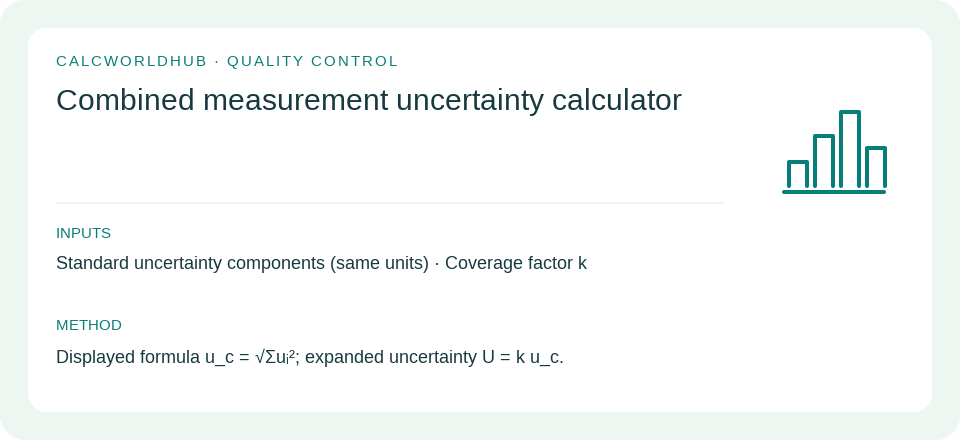
u_c = √Σuᵢ²; expanded uncertainty U = k u_c.
Worked example
For components 0.12, 0.08, and 0.05 units, u_c = √(0.0144+0.0064+0.0025) = 0.1526 units; k=2 gives U=0.3051 units.
Assumptions and limits
Assumes independent components and compatible units. Correlated sources require covariance terms; coverage factor alone does not guarantee a particular coverage probability.
Frequently asked questions
Can I combine percentages and millimetres?
Convert every component to compatible units and the same measurand before combining.
When is root-sum-square not suitable?
Correlated components require covariance terms; some uncertainty budgets also require sensitivity coefficients.
Does k=2 always mean 95% coverage?
Not necessarily. Coverage depends on distributions, degrees of freedom, and the uncertainty model.
How do I use the Combined measurement uncertainty calculator?
Enter Standard uncertainty components (same units), Coverage factor k. Match the units shown beside each field and review the result together with the assumptions below.
What is a worked example of Combined measurement uncertainty?
For components 0.12, 0.08, and 0.05 units, u_c = √(0.0144+0.0064+0.0025) = 0.1526 units; k=2 gives U=0.3051 units.
Reference: NIST uncertainty guidance. See our calculation methodology.