How to use this calculator
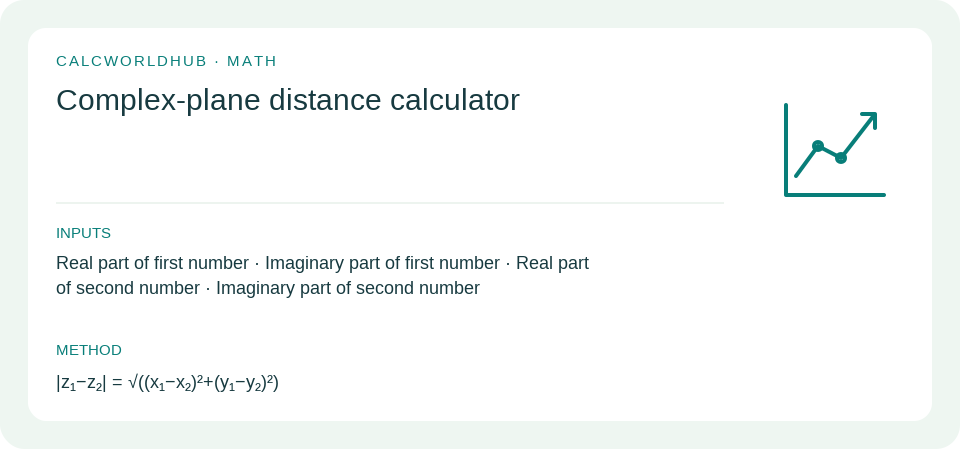
Find the Euclidean distance between two complex numbers by treating real and imaginary parts as plane coordinates.
- Enter Real part of first number, Imaginary part of first number, Real part of second number, Imaginary part of second number. Match the units shown beside each field and review the result together with the assumptions below.
- Read the worked example below to check the expected input format and result.
- Compare another scenario by changing one input at a time. Use Reset to return to the starting values.
How Complex-plane distance calculator works
Find the Euclidean distance between two complex numbers by treating real and imaginary parts as plane coordinates.
Inputs and units
- Real part of first number: Enter the first complex number's real coordinate.
- Imaginary part of first number: Enter its imaginary coordinate, the coefficient of i.
- Real part of second number: Enter the second complex number's real coordinate.
- Imaginary part of second number: Enter its imaginary coordinate; all coordinates use the same scale.
Formula and method
|z₁−z₂| = √((x₁−x₂)²+(y₁−y₂)²)
Worked example
For z₁=2+3i and z₂=4−i, coordinate differences are −2 and 4; distance = √(4+16)=√20≈4.47214.
Interpreting the result
The result is a nonnegative Euclidean distance in the coordinate scale. Identical complex numbers have distance zero.
Assumptions and limits
Real and imaginary coordinates must share the same scale. The distance is a magnitude, not the complex difference itself, and it does not preserve direction or phase.
Frequently asked questions
Why is complex distance always nonnegative?
It is the square root of the sum of squared coordinate differences.
Does this return z₁−z₂?
No. It returns the magnitude |z₁−z₂|; the complex difference also has real and imaginary components.
How do I use the Complex-plane distance calculator?
Enter Real part of first number, Imaginary part of first number, Real part of second number, Imaginary part of second number. Match the units shown beside each field and review the result together with the assumptions below.
What is a worked example of Complex-plane distance?
For z₁=2+3i and z₂=4−i, coordinate differences are −2 and 4; distance = √(4+16)=√20≈4.47214.
What does the Complex-plane distance calculator calculate?
Find the Euclidean distance between two complex numbers by treating real and imaginary parts as plane coordinates.