How to use this calculator
Composite Simpson’s 1/3 rule approximates an integral from equally spaced values using alternating weights.
- Enter Function values from left to right, Uniform spacing h. Match the units shown beside each field and review the result together with the assumptions below.
- Read the worked example below to check the expected input format and result.
- Compare another scenario by changing one input at a time. Use Reset to return to the starting values.
How Composite Simpson integration calculator works
Composite Simpson’s 1/3 rule approximates an integral from equally spaced values using alternating weights.
Inputs and units
- Function values from left to right: Enter at least three finite function samples from left to right; the number of subintervals must be even.
- Uniform spacing h: h is the uniform spacing between adjacent x values; it may be signed to encode integration direction.
Formula and method
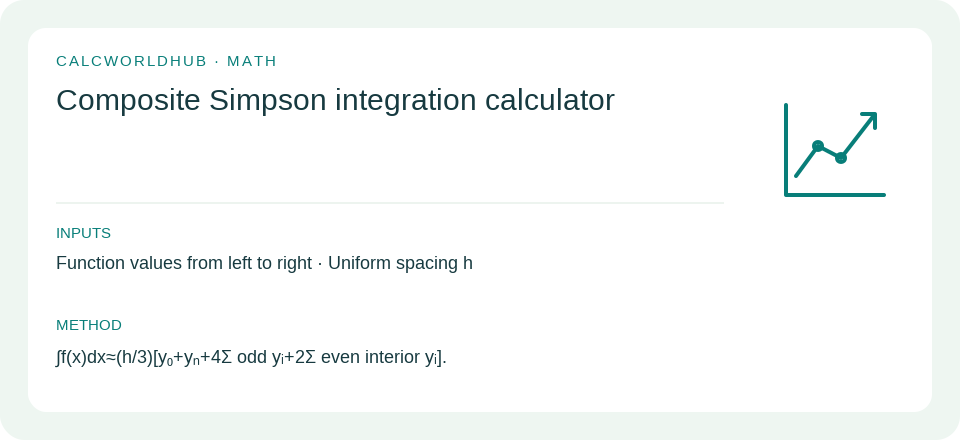
∫f(x)dx≈(h/3)[y₀+yₙ+4Σ odd yᵢ+2Σ even interior yᵢ].
Worked example
For f(x)=x² at x=0,1,2, the values 0,1,4 give (1/3)(0+4+4·1)=8/3≈2.666667, exactly the integral on [0,2].
Interpreting the result
The result estimates signed area. Simpson’s rule is exact for cubic polynomials with equal spacing, and often performs well for smooth functions.
Assumptions and limits
The samples must be equally spaced and the interval count even. Irregular spacing, sharp discontinuities, and noisy samples need a different method or an explicit error analysis.
Sources and method
- Composite trapezoidal and Simpson rules use regularly spaced samples; Simpson requires an even number of intervals. OpenStax: numerical integration
Frequently asked questions
Why must the interval count be even?
Simpson’s 1/3 rule applies over pairs of adjacent subintervals.
What if samples are irregularly spaced?
The displayed formula does not apply; use a method that accepts the actual x coordinates.
How do I use the Composite Simpson integration calculator?
Enter Function values from left to right, Uniform spacing h. Match the units shown beside each field and review the result together with the assumptions below.
What is a worked example of Composite Simpson integration?
For f(x)=x² at x=0,1,2, the values 0,1,4 give (1/3)(0+4+4·1)=8/3≈2.666667, exactly the integral on [0,2].
What does the Composite Simpson integration calculator calculate?
Composite Simpson’s 1/3 rule approximates an integral from equally spaced values using alternating weights.