How to use this calculator
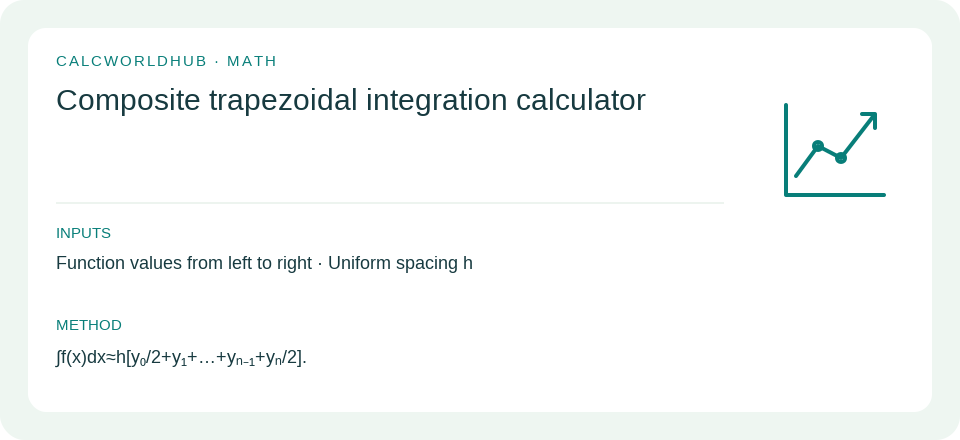
The composite trapezoidal rule adds trapezoid areas between adjacent equally spaced function samples.
- Enter Function values from left to right, Uniform spacing h. Match the units shown beside each field and review the result together with the assumptions below.
- Read the worked example below to check the expected input format and result.
- Compare another scenario by changing one input at a time. Use Reset to return to the starting values.
How Composite trapezoidal integration calculator works
The composite trapezoidal rule adds trapezoid areas between adjacent equally spaced function samples.
Inputs and units
- Function values from left to right: Enter at least two finite function values from left to right, with equal spacing.
- Uniform spacing h: h is the signed uniform spacing between adjacent sample points.
Formula and method
∫f(x)dx≈h[y₀/2+y₁+…+yₙ₋₁+yₙ/2].
Worked example
For f(x)=x² at x=0,1,2, the values 0,1,4 give 1[0/2+1+4/2]=3.
Interpreting the result
The estimate is signed area and has units of function value times x spacing. The example overestimates the exact value 8/3 because x² is convex.
Assumptions and limits
At least two equally spaced values are required. Curvature and spacing affect approximation error; the tool does not estimate an error bound.
Sources and method
- Composite trapezoidal and Simpson rules use regularly spaced samples; Simpson requires an even number of intervals. OpenStax: numerical integration
Frequently asked questions
Why are endpoint values halved?
Each endpoint belongs to only one trapezoid while interior points are shared by adjacent trapezoids.
Can the rule integrate a decreasing function?
Yes. It estimates signed area using the supplied sample order and signed spacing.
How do I use the Composite trapezoidal integration calculator?
Enter Function values from left to right, Uniform spacing h. Match the units shown beside each field and review the result together with the assumptions below.
What is a worked example of Composite trapezoidal integration?
For f(x)=x² at x=0,1,2, the values 0,1,4 give 1[0/2+1+4/2]=3.
What does the Composite trapezoidal integration calculator calculate?
The composite trapezoidal rule adds trapezoid areas between adjacent equally spaced function samples.