How to use this calculator
Solve the Rachford–Rice phase fraction using supplied equilibrium K values and feed composition.
- Enter Feed component mole fractions or positive weights, Matching vapor-liquid K values. Match the units shown beside each field and review the result together with the assumptions below.
- Read the worked example below to check the expected input format and result.
- Compare another scenario by changing one input at a time. Use Reset to return to the starting values.
Constant K vapor liquid flash split explained
With fixed component K values, solve the Rachford–Rice material balance for vapor fraction and phase compositions.
A numerical walkthrough
Feed component mole fractions or positive weights = 0.5, 0.5; Matching vapor-liquid K values = 2, 0.5.
- Vapor mole fraction: 0.5
- Phase classification: Two-phase equilibrium
- Liquid composition: 0.33333333, 0.66666667
- Vapor composition: 0.66666667, 0.33333333
At vapor fraction one half, liquid fractions are 1/3 and 2/3. Multiplying by K gives vapor fractions 2/3 and 1/3; equal phase amounts recover the original 0.5/0.5 feed.
The model behind the numbers
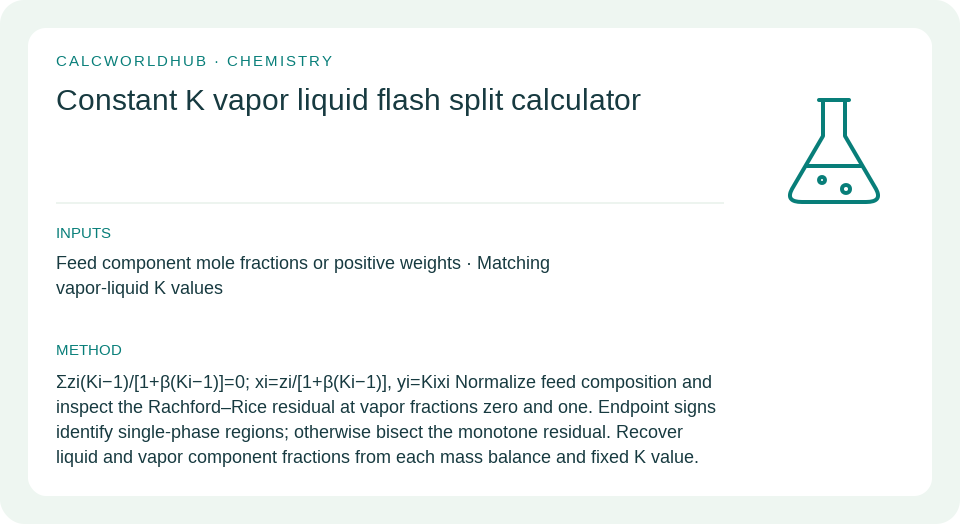
Σzi(Ki−1)/[1+β(Ki−1)]=0; xi=zi/[1+β(Ki−1)], yi=Kixi
Normalize feed composition and inspect the Rachford–Rice residual at vapor fractions zero and one. Endpoint signs identify single-phase regions; otherwise bisect the monotone residual. Recover liquid and vapor component fractions from each mass balance and fixed K value.
What to enter
z— Feed component mole fractions or positive weights- Feed component mole fractions or positive weights. Use comma-separated values in the stated order.
k— Matching vapor-liquid K values- Matching vapor-liquid K values. Use comma-separated values in the stated order.
Interpreting the result
K values are fixed inputs, not predicted from temperature, pressure, or an equation of state. Single-phase states are identified; liquid and vapor compositions are only shown for present phases.
Frequently asked questions
What is a K value?
Equilibrium vapor mole fraction divided by liquid mole fraction for that component.
Can all K values equal one?
Phase fraction is then undetermined and rejected.
Are feed weights normalized?
Yes, nonnegative weights with positive total are normalized.
How do I use the Constant K vapor liquid flash split calculator?
Enter Feed component mole fractions or positive weights, Matching vapor-liquid K values. Match the units shown beside each field and review the result together with the assumptions below.
What is a worked example of Constant K vapor liquid flash split?
Feed component mole fractions or positive weights = 0.5, 0.5; Matching vapor-liquid K values = 2, 0.5. Vapor mole fraction: 0.5 Phase classification: Two-phase equilibrium Liquid composition: 0.33333333, 0.66666667 Vapor composition: 0.66666667, 0.33333333 At vapor fraction one half, liquid fractions are 1/3 and 2/3. Multiplying by K gives vapor fractions 2/3 and 1/3; equal phase amounts recover the original 0.5/0.5 feed.
External model references: Rachford and Rice (1952), flash vaporization equilibrium procedure. These references support the stated correction or definition; calculator assumptions and limits remain as described above.
Read our calculation methodology.