How to use this calculator
Inspect how an explicitly defined logarithmic compander allocates amplitude resolution near a chosen signal level before selecting a quantizer.
- Enter Normalized input amplitude, Mu compression parameter, Compressed-domain small step. Match the units shown beside each field and review the result together with the assumptions below.
- Read the worked example below to check the expected input format and result.
- Compare another scenario by changing one input at a time. Use Reset to return to the starting values.
Continuous mu-law compander transfer and local resolution explained
How the calculation works
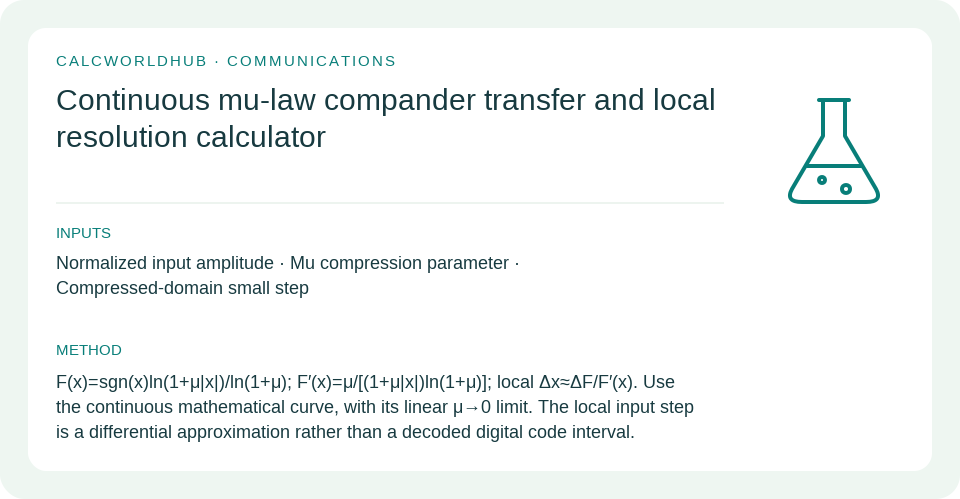
F(x)=sgn(x)ln(1+μ|x|)/ln(1+μ); F′(x)=μ/[(1+μ|x|)ln(1+μ)]; local Δx≈ΔF/F′(x).
Use the continuous mathematical curve, with its linear μ→0 limit. The local input step is a differential approximation rather than a decoded digital code interval.
Set up the calculation
x— Normalized input amplitude- Signed full-scale-normalized amplitude before compression.
mu— Mu compression parameter- Nonnegative logarithmic compression strength; zero gives a linear transfer.
step— Compressed-domain small step- Small positive normalized amplitude interval near the operating point.
Limits of this model
Continuous curve only; this is not a bit-exact G.711 encoder and does not implement segmented codewords, bit inversion or a quantizer. Large steps need exact inverse differences.
Check this example
Normalized input amplitude = 0.02; Mu compression parameter = 255; Compressed-domain small step = 0.001.
- Continuous compressed amplitude: 0.326101 normalized
- Local compression slope: 7.538673 compressed/input amplitude
- Local input amplitude per entered compressed step: 0.000133 normalized
At normalized input 0.02 and mu 255, a compressed-domain step of 0.001 corresponds to a smaller input change than it does near full scale.
Reading the outputs
Compressed amplitude retains sign and is bounded by full scale. Local slope is dimensionless, and the equivalent input step indicates local resolution allocation.
Frequently asked questions
Is mu 255 enough to generate a G.711 byte?
No; a specific encoder also needs its exact segmentation, quantization and codeword mapping.
Does compression improve physical input SNR?
It redistributes quantizer resolution; it does not remove noise already present in the analog signal.
Why is resolution different near zero?
The logarithmic curve has higher slope near small amplitudes, assigning more compressed-domain range per input increment.
How do I use the Continuous mu-law compander transfer and local resolution calculator?
Enter Normalized input amplitude, Mu compression parameter, Compressed-domain small step. Match the units shown beside each field and review the result together with the assumptions below.
What is a worked example of Continuous mu-law compander transfer and local resolution?
Normalized input amplitude = 0.02; Mu compression parameter = 255; Compressed-domain small step = 0.001. Continuous compressed amplitude: 0.326101 normalized Local compression slope: 7.538673 compressed/input amplitude Local input amplitude per entered compressed step: 0.000133 normalized At normalized input 0.02 and mu 255, a compressed-domain step of 0.001 corresponds to a smaller input change than it does near full scale.
Read our calculation methodology.