How to use this calculator
Estimate a convection coefficient from heat-transfer rate, surface area, and surface-to-fluid temperature difference.
- Enter Convective heat-transfer rate (W), Exposed surface area (m²), Surface temperature (°C), Surrounding fluid temperature (°C). Match the units shown beside each field and review the result together with the assumptions below.
- Read the worked example below to check the expected input format and result.
- Compare another scenario by changing one input at a time. Use Reset to return to the starting values.
How this calculation works
Newton's law of cooling relates convective heat rate to surface area, a temperature difference, and a heat-transfer coefficient. Solving for the coefficient gives a convenient measured or design estimate when those quantities are known.
Inputs and units
heatRate— Convective heat-transfer rate (W)- Enter the magnitude of heat transferred by convection for this surface.
area— Exposed surface area (m²)- Use area participating in the stated heat-transfer rate.
surfaceTemperature— Surface temperature (°C)- Use the representative surface temperature.
fluidTemperature— Surrounding fluid temperature (°C)- Use the representative bulk fluid temperature away from the boundary layer.
Formula
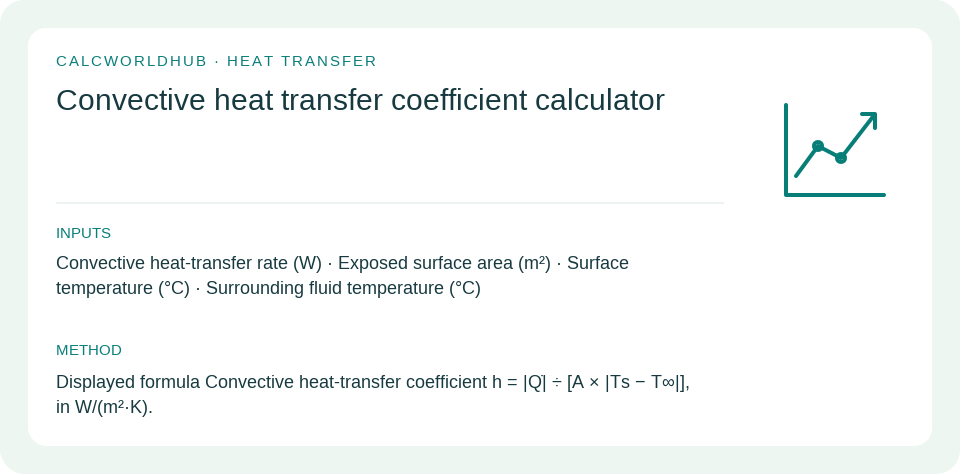
Convective heat-transfer coefficient h = |Q̇| ÷ [A × |Ts − T∞|], in W/(m²·K).
Method
Enter heat-transfer rate in watts, exposed surface area in square metres, and surface and surrounding-fluid temperatures in °C. The absolute temperature difference has the same numerical size in kelvins.
Worked example
For 500 W transferred over 2 m² with a 25 K surface-to-fluid temperature difference, h = 500 ÷ (2 × 25) = 10 W/(m²·K).
Assumptions and limits
The result is an effective coefficient for the stated area and operating condition. Natural or forced convection, geometry, flow regime, radiation, and measurement uncertainty can affect the inferred value; this does not independently separate those effects.
Frequently asked questions
Does this coefficient include radiation?
The formula represents convection. If the measured heat rate also includes radiation, the inferred value is only an effective combined estimate unless radiation is separated.
Can Celsius be used for the temperature difference?
Yes. A temperature difference of 1°C equals a difference of 1 K.
Does one coefficient apply at every flow speed?
No. Convection depends on flow, geometry, and fluid properties, so coefficients can change with operating conditions.
How do I use the Convective heat transfer coefficient calculator?
Enter Convective heat-transfer rate (W), Exposed surface area (m²), Surface temperature (°C), Surrounding fluid temperature (°C). Match the units shown beside each field and review the result together with the assumptions below.
What is a worked example of Convective heat transfer coefficient?
For 500 W transferred over 2 m² with a 25 K surface-to-fluid temperature difference, h = 500 ÷ (2 × 25) = 10 W/(m²·K).
Read our calculation methodology.