How to use this calculator
Estimate a wet cooling coil’s leaving air state and condensate removal from its apparatus dew point and bypass factor.
- Enter Inlet dry-bulb temperature (°C), Inlet humidity ratio (kg/kg dry air), Apparatus dew-point temperature (°C), Saturated humidity ratio at apparatus dew point (kg/kg dry air), then complete the remaining labeled fields. Match the units shown beside each field and review the result together with the assumptions below.
- Read the worked example below to check the expected input format and result.
- Compare another scenario by changing one input at a time. Use Reset to return to the starting values.
Cooling-coil bypass factor and condensate balance explained
The bypass-factor model mixes inlet air with the apparatus-dew-point state to estimate outlet humidity, condensate and approximate cooling duty.
How the calculation works
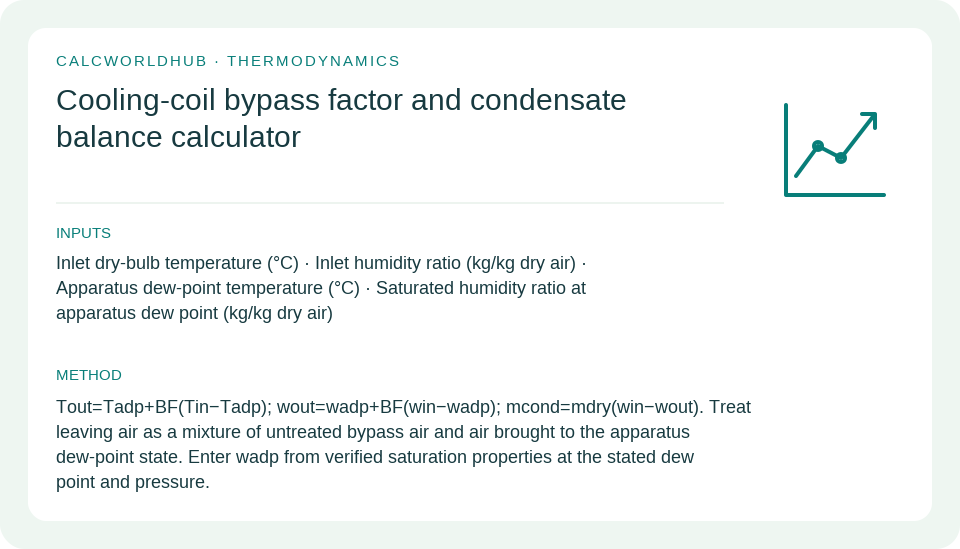
Tout=Tadp+BF(Tin−Tadp); wout=wadp+BF(win−wadp); mcond=mdry(win−wout).
Treat leaving air as a mixture of untreated bypass air and air brought to the apparatus dew-point state. Enter wadp from verified saturation properties at the stated dew point and pressure.
Set up the calculation
Ti— Inlet dry-bulb temperature (°C)- Inlet dry-bulb temperature (°C). Enter the value for this state; the units shown are used without an unstated conversion.
wi— Inlet humidity ratio (kg/kg dry air)- Inlet humidity ratio (kg/kg dry air). Enter the value for this state; the units shown are used without an unstated conversion.
Tb— Apparatus dew-point temperature (°C)- Apparatus dew-point temperature (°C). Enter the value for this state; the units shown are used without an unstated conversion.
wb— Saturated humidity ratio at apparatus dew point (kg/kg dry air)- Saturated humidity ratio at apparatus dew point (kg/kg dry air). Enter the value for this state; the units shown are used without an unstated conversion.
bf— Coil bypass factor- Coil bypass factor. Enter the value for this state; the units shown are used without an unstated conversion.
m— Dry-air mass flow (kg/s)- Dry-air mass flow (kg/s). Enter the value for this state; the units shown are used without an unstated conversion.
Limits of this model
Ideal straight-line bypass model with supplied dew-point humidity ratio. Cooling duty neglects condensate sensible enthalpy, fan heat and pressure drop; no frost or partially wet coil model.
Check this example
Inlet dry-bulb temperature (°C) = 30; Inlet humidity ratio (kg/kg dry air) = 0.014; Apparatus dew-point temperature (°C) = 10; Saturated humidity ratio at apparatus dew point (kg/kg dry air) = 0.00763; Coil bypass factor = 0.15; Dry-air mass flow (kg/s) = 1.
- Leaving dry-bulb temperature: 13 °C
- Leaving humidity ratio: 0.008585 kg/kg dry air
- Condensate mass flow: 0.005415 kg/s
- Approximate air-side cooling duty: 31.217267 kW
Air at 30 °C and humidity ratio 0.014 approaches a 10 °C apparatus-dew-point state with humidity ratio 0.00763 through a coil with 15% bypass. Outlet air is 13 °C and 0.0085855 kg/kg dry air; at 1 kg/s dry air, condensate is 0.0054145 kg/s.
Reading the outputs
Reports leaving temperature, leaving moisture per dry-air mass, condensate rate and moist-air enthalpy reduction in kW.
Frequently asked questions
Is bypass factor an air leakage fraction?
It is an effective heat/mass-transfer parameter; it need not equal a literal leaking air fraction.
What happens at BF=1?
The air leaves unchanged and the predicted duty and condensate are zero.
Why must apparatus dew-point humidity be supplied?
It depends on pressure and saturation temperature; use a consistent property source.
How do I use the Cooling-coil bypass factor and condensate balance calculator?
Enter Inlet dry-bulb temperature (°C), Inlet humidity ratio (kg/kg dry air), Apparatus dew-point temperature (°C), Saturated humidity ratio at apparatus dew point (kg/kg dry air), then complete the remaining labeled fields. Match the units shown beside each field and review the result together with the assumptions below.
What is a worked example of Cooling-coil bypass factor and condensate balance?
Inlet dry-bulb temperature (°C) = 30; Inlet humidity ratio (kg/kg dry air) = 0.014; Apparatus dew-point temperature (°C) = 10; Saturated humidity ratio at apparatus dew point (kg/kg dry air) = 0.00763; Coil bypass factor = 0.15; Dry-air mass flow (kg/s) = 1. Leaving dry-bulb temperature: 13 °C Leaving humidity ratio: 0.008585 kg/kg dry air Condensate mass flow: 0.005415 kg/s Approximate air-side cooling duty: 31.217267 kW Air at 30 °C and humidity ratio 0.014 approaches a 10 °C apparatus-dew-point state with humidity ratio 0.00763 through a coil with 15% bypass. Outlet air is 13 °C and 0.0085855 kg/kg dry air; at 1 kg/s dry air, condensate is 0.0054145 kg/s.
Background or definition reference: EnergyPlus cooling coil apparatus dew-point and bypass-factor model.
Read our calculation methodology.