How to use this calculator
Balance evaporative water loss and dissolved-solids concentration to estimate blowdown and makeup.
- Enter Evaporation flow (m³/hour), Drift and other liquid losses (m³/hour), Desired cycles of concentration. Match the units shown beside each field and review the result together with the assumptions below.
- Read the worked example below to check the expected input format and result.
- Compare another scenario by changing one input at a time. Use Reset to return to the starting values.
Cooling tower concentration water balance explained
Use Evaporation flow (m³/hour) with Drift and other liquid losses (m³/hour) to reproduce the sample calculation, then review the stated limits before carrying the result into another scenario.
How the calculation works
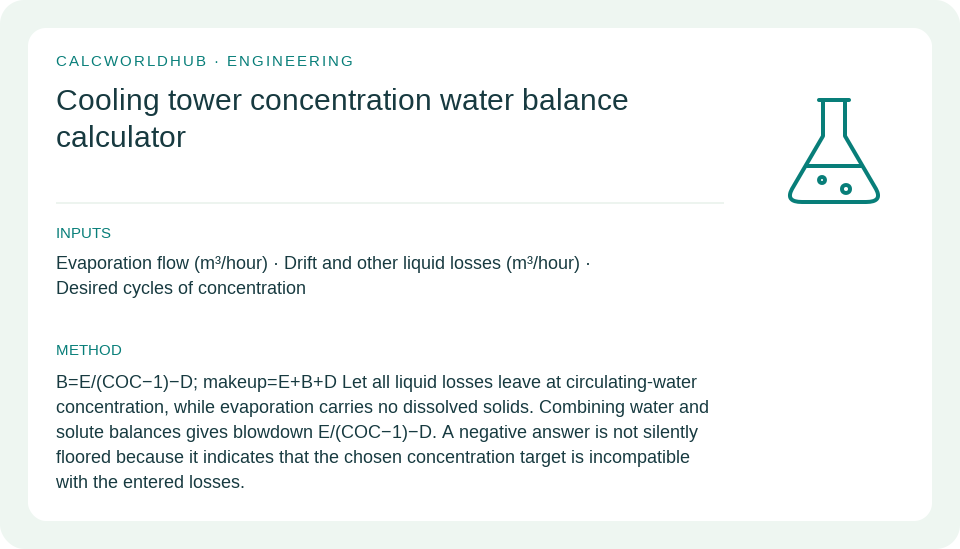
B=E/(COC−1)−D; makeup=E+B+D
Let all liquid losses leave at circulating-water concentration, while evaporation carries no dissolved solids. Combining water and solute balances gives blowdown E/(COC−1)−D. A negative answer is not silently floored because it indicates that the chosen concentration target is incompatible with the entered losses.
Set up the calculation
e— Evaporation flow (m³/hour)- Evaporation flow (m³/hour).
d— Drift and other liquid losses (m³/hour)- Drift and other liquid losses (m³/hour).
c— Desired cycles of concentration- Desired cycles of concentration.
Limits of this model
Steady state, no dissolved solids in evaporated water, and drift at circulating concentration. Leaks belong in the liquid-loss input if at that concentration.
Check this example
Evaporation flow (m³/hour) = 2; Drift and other liquid losses (m³/hour) = 0.1; Desired cycles of concentration = 5.
- Required blowdown: 0.4 m³/hour
- Required makeup: 2.5 m³/hour
At five concentration cycles and 2 m³/hour evaporation, total concentrated liquid removal is 2/(5−1)=0.5 m³/hour. Drift already removes 0.1, leaving 0.4 blowdown and 2.5 makeup.
Frequently asked questions
Does evaporation remove dissolved solids?
It is treated as pure water loss in this balance.
Why can drift reduce needed blowdown?
Drift already removes concentrated liquid.
What if calculated blowdown is negative?
The desired concentration cannot be maintained with these losses under this model.
How do I use the Cooling tower concentration water balance calculator?
Enter Evaporation flow (m³/hour), Drift and other liquid losses (m³/hour), Desired cycles of concentration. Match the units shown beside each field and review the result together with the assumptions below.
What is a worked example of Cooling tower concentration water balance?
Evaporation flow (m³/hour) = 2; Drift and other liquid losses (m³/hour) = 0.1; Desired cycles of concentration = 5. Required blowdown: 0.4 m³/hour Required makeup: 2.5 m³/hour At five concentration cycles and 2 m³/hour evaporation, total concentrated liquid removal is 2/(5−1)=0.5 m³/hour. Drift already removes 0.1, leaving 0.4 blowdown and 2.5 makeup.
Read our calculation methodology.