How to use this calculator
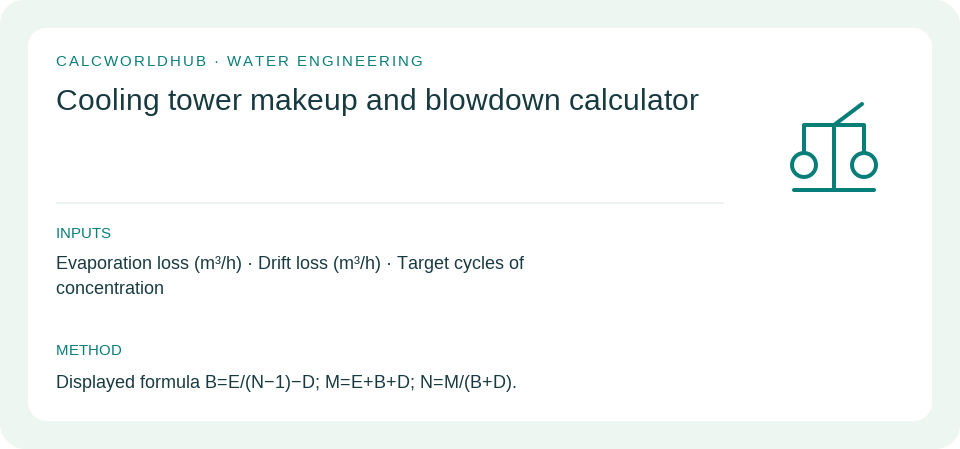
Estimate cooling-tower makeup and blowdown flow from evaporation, drift loss, and the target cycles of concentration.
- Enter Evaporation loss (m³/h), Drift loss (m³/h), Target cycles of concentration. Match the units shown beside each field and review the result together with the assumptions below.
- Read the worked example below to check the expected input format and result.
- Compare another scenario by changing one input at a time. Use Reset to return to the starting values.
How this calculation works
Cooling-tower evaporation removes water while leaving most dissolved solids behind. Enter measured or estimated evaporation and drift loss plus the target concentration cycles to estimate the blowdown needed to maintain that target and the resulting makeup flow.
Inputs and units
evaporation— Evaporation loss (m³/h)- Water evaporated from the tower per hour; must be positive.
drift— Drift loss (m³/h)- Liquid droplets carried out of the tower per hour.
cycles— Target cycles of concentration- Concentration ratio above 1; higher cycles reduce blowdown for a given evaporation rate.
Formula
B=E/(N−1)−D; M=E+B+D; N=M/(B+D).
Method
E is evaporation, D is drift loss, B is blowdown, M is makeup, and N is the target cycles of concentration. All flow inputs must use the same rate unit.
Worked example
For 10 m³/h evaporation, 0.1 m³/h drift and 5 cycles, blowdown is 2.4 m³/h and makeup is 12.5 m³/h.
Assumptions and limits
This steady-state mass balance assumes dissolved solids leave only through blowdown and drift, with no leaks, precipitation, or changing basin storage. It estimates flows; it does not assess water chemistry, scaling, treatment limits, or discharge rules.
Frequently asked questions
What are cycles of concentration?
They compare dissolved-solids concentration in circulating tower water with that in makeup water.
Why does drift affect blowdown?
Drift carries liquid droplets and dissolved solids out of the system, so less blowdown is needed for the same target ratio.
Does this include blowdown treatment or discharge limits?
No. It is a water-flow balance only; local discharge rules and chemistry controls are separate.
How do I use the Cooling tower makeup and blowdown calculator?
Enter Evaporation loss (m³/h), Drift loss (m³/h), Target cycles of concentration. Match the units shown beside each field and review the result together with the assumptions below.
What is a worked example of Cooling tower makeup and blowdown?
For 10 m³/h evaporation, 0.1 m³/h drift and 5 cycles, blowdown is 2.4 m³/h and makeup is 12.5 m³/h.
Reference: U.S. Department of Energy wind guidebook. See our calculation methodology.