How to use this calculator
Describe cooperative binding occupancy from a fitted Hill concentration and exponent.
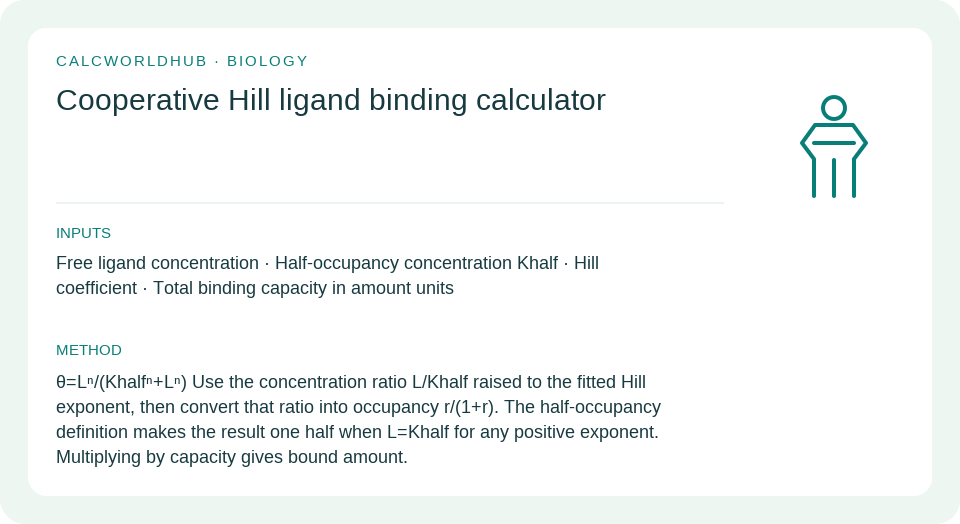
- Enter Free ligand concentration, Half-occupancy concentration Khalf, Hill coefficient, Total binding capacity in amount units. Match the units shown beside each field and review the result together with the assumptions below.
- Read the worked example below to check the expected input format and result.
- Compare another scenario by changing one input at a time. Use Reset to return to the starting values.
Cooperative Hill ligand binding explained
Estimate fractional ligand occupancy from free ligand concentration, dissociation constant, and the Hill coefficient.
How the calculation works
θ=Lⁿ/(Khalfⁿ+Lⁿ)
Use the concentration ratio L/Khalf raised to the fitted Hill exponent, then convert that ratio into occupancy r/(1+r). The half-occupancy definition makes the result one half when L=Khalf for any positive exponent. Multiplying by capacity gives bound amount.
Inputs and units
l— Free ligand concentration- Free ligand concentration.
k— Half-occupancy concentration Khalf- Half-occupancy concentration Khalf.
n— Hill coefficient- Hill coefficient.
total— Total binding capacity in amount units- Total binding capacity in amount units.
Limits of this model
Phenomenological Hill fit; the exponent need not equal a literal binding-site count. Free ligand must be supplied, so depletion is not solved.
Check this example
Free ligand concentration = 3; Half-occupancy concentration Khalf = 2; Hill coefficient = 2; Total binding capacity in amount units = 10.
- Hill fractional occupancy: 0.69230769
- Bound amount at stated capacity: 6.92307692 amount units
The ratio (3/2)² is 2.25, so occupancy is 2.25/(1+2.25)=9/13. A capacity of ten gives 90/13 amount units bound.
Frequently asked questions
Is Khalf always a microscopic dissociation constant?
No, it is the concentration giving half occupancy in this model.
Does n=1 reduce to a hyperbola?
Yes.
Can n prove a particular molecular mechanism?
No.
How do I use the Cooperative Hill ligand binding calculator?
Enter Free ligand concentration, Half-occupancy concentration Khalf, Hill coefficient, Total binding capacity in amount units. Match the units shown beside each field and review the result together with the assumptions below.
What is a worked example of Cooperative Hill ligand binding?
Free ligand concentration = 3; Half-occupancy concentration Khalf = 2; Hill coefficient = 2; Total binding capacity in amount units = 10. Hill fractional occupancy: 0.69230769 Bound amount at stated capacity: 6.92307692 amount units The ratio (3/2)² is 2.25, so occupancy is 2.25/(1+2.25)=9/13. A capacity of ten gives 90/13 amount units bound.
Sources
Read our calculation methodology.