How to use this calculator
Solve equilibrium complex concentration when ligand depletion cannot be ignored.
- Enter Total receptor concentration, Total ligand concentration, Dissociation constant Kd. Match the units shown beside each field and review the result together with the assumptions below.
- Read the worked example below to check the expected input format and result.
- Compare another scenario by changing one input at a time. Use Reset to return to the starting values.
One to one ligand receptor mass balance explained
Solve a one-site ligand–receptor equilibrium mass balance for bound and free concentrations from totals and dissociation constant.
A numerical walkthrough
Total receptor concentration = 10; Total ligand concentration = 5; Dissociation constant Kd = 2.
- Equilibrium complex concentration: 3.78300943 concentration units
- Free ligand: 1.21699057 concentration units
- Free receptor: 6.21699057 concentration units
With B = 3.783009 concentration units, free ligand is Lt − B = 1.216991 and free receptor is Rt − B = 6.216991; both mass balances recover the entered totals.
The model behind the numbers
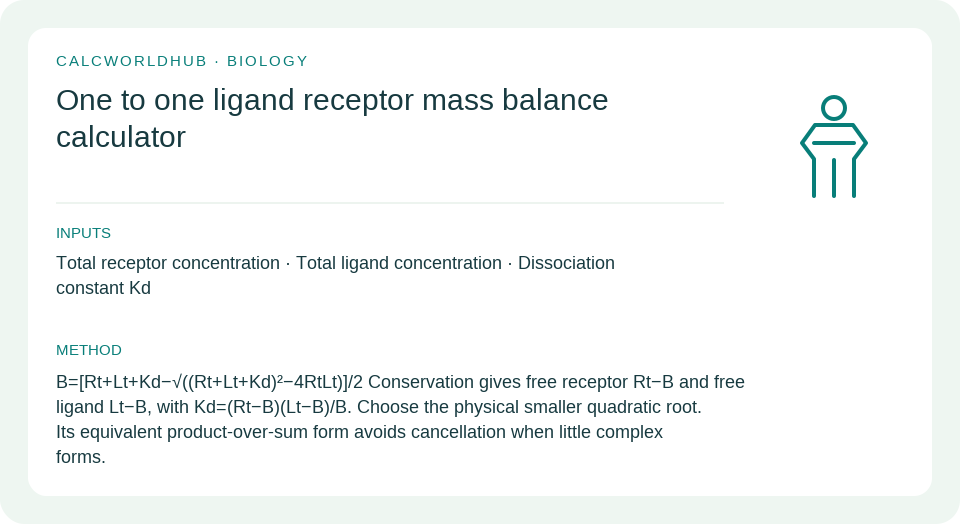
B=[Rt+Lt+Kd−√((Rt+Lt+Kd)²−4RtLt)]/2
Conservation gives free receptor Rt−B and free ligand Lt−B, with Kd=(Rt−B)(Lt−B)/B. Choose the physical smaller quadratic root. Its equivalent product-over-sum form avoids cancellation when little complex forms.
What to enter
rt— Total receptor concentration- Total receptor concentration.
lt— Total ligand concentration- Total ligand concentration.
kd— Dissociation constant Kd- Dissociation constant Kd.
Interpreting the result
One ligand per receptor, a single equilibrium Kd, and ideal concentrations in one common unit. No cooperative or competing binding is included.
Frequently asked questions
Why not use Lt/(Kd+Lt)?
Total ligand can differ materially from free ligand when binding depletes it.
Must both concentrations use the same units?
Yes, including Kd.
Does it model binding kinetics?
No, equilibrium only.
How do I use the One to one ligand receptor mass balance calculator?
Enter Total receptor concentration, Total ligand concentration, Dissociation constant Kd. Match the units shown beside each field and review the result together with the assumptions below.
What is a worked example of One to one ligand receptor mass balance?
Total receptor concentration = 10; Total ligand concentration = 5; Dissociation constant Kd = 2. Equilibrium complex concentration: 3.78300943 concentration units Free ligand: 1.21699057 concentration units Free receptor: 6.21699057 concentration units With B = 3.783009 concentration units, free ligand is Lt − B = 1.216991 and free receptor is Rt − B = 6.216991; both mass balances recover the entered totals.
Read our calculation methodology.