How to use this calculator
Partition a single receptor site among empty, A-bound, and B-bound states using free ligand concentrations.
- Enter Free concentration of ligand A, Free concentration of ligand B, Dissociation constant of A, Dissociation constant of B. Match the units shown beside each field and review the result together with the assumptions below.
- Read the worked example below to check the expected input format and result.
- Compare another scenario by changing one input at a time. Use Reset to return to the starting values.
Two ligand competitive receptor occupancy explained
Competitive binding weights each ligand by its free concentration relative to its dissociation constant. Normalizing those weights with the unbound state gives the fraction of receptors occupied by each ligand under a one-site equilibrium model.
Inputs, symbols, and units
a— Free concentration of ligand A- Free concentration of ligand A.
b— Free concentration of ligand B- Free concentration of ligand B.
ka— Dissociation constant of A- Dissociation constant of A.
kb— Dissociation constant of B- Dissociation constant of B.
Formula and method
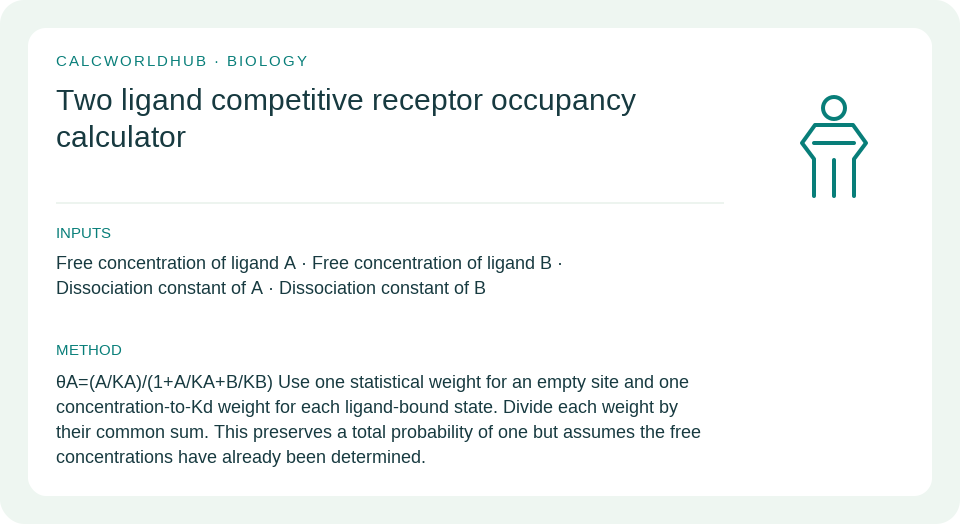
θA=(A/KA)/(1+A/KA+B/KB)
Use one statistical weight for an empty site and one concentration-to-Kd weight for each ligand-bound state. Divide each weight by their common sum. This preserves a total probability of one but assumes the free concentrations have already been determined.
A worked scenario
Free concentration of ligand A = 5; Free concentration of ligand B = 10; Dissociation constant of A = 2; Dissociation constant of B = 5.
- A-bound receptor fraction: 0.45454545
- B-bound receptor fraction: 0.36363636
- Empty receptor fraction: 0.18181818
This scenario uses the stated units and assumptions. Displayed values are rounded only after calculation.
Assumptions and edge cases
Mutually exclusive one-site equilibrium binding; ligand depletion, allosteric sites, and kinetic displacement are excluded.
Frequently asked questions
Can both ligands occupy the same site at once?
Not in this model.
Are total ligand concentrations accepted?
Only when they adequately approximate free concentrations.
Do the three state fractions sum to one?
Yes.
How do I use the Two ligand competitive receptor occupancy calculator?
Enter Free concentration of ligand A, Free concentration of ligand B, Dissociation constant of A, Dissociation constant of B. Match the units shown beside each field and review the result together with the assumptions below.
What is a worked example of Two ligand competitive receptor occupancy?
Free concentration of ligand A = 5; Free concentration of ligand B = 10; Dissociation constant of A = 2; Dissociation constant of B = 5. A-bound receptor fraction: 0.45454545 B-bound receptor fraction: 0.36363636 Empty receptor fraction: 0.18181818 This scenario uses the stated units and assumptions. Displayed values are rounded only after calculation.
Read our calculation methodology.