How to use this calculator
Update an existing battery state-of-charge estimate from measured current while accounting for charging coulombic efficiency.
- Enter Initial state of charge (%), Usable charge capacity (Ah), Signed terminal current (A), Interval duration (h), then complete the remaining labeled fields. Match the units shown beside each field and review the result together with the assumptions below.
- Read the worked example below to check the expected input format and result.
- Compare another scenario by changing one input at a time. Use Reset to return to the starting values.
Coulomb-counted battery state of charge explained
Coulomb counting accumulates signed current over time to update stored charge. This convention treats positive current as discharge and negative current as charge; charge efficiency reduces incoming charge, and capacity maps amp-hours to state-of-charge percentage points.
Inputs, symbols, and units
soc— Initial state of charge (%)- Starting charge estimate before the interval.
Ah— Usable charge capacity (Ah)- Effective capacity in ampere-hours at present conditions.
I— Signed terminal current (A)- Positive discharges; negative charges the battery.
hours— Interval duration (h)- Duration at constant current.
eta— Charge coulombic efficiency- Stored charge divided by incoming charge; applies only during charging.
Formula and method
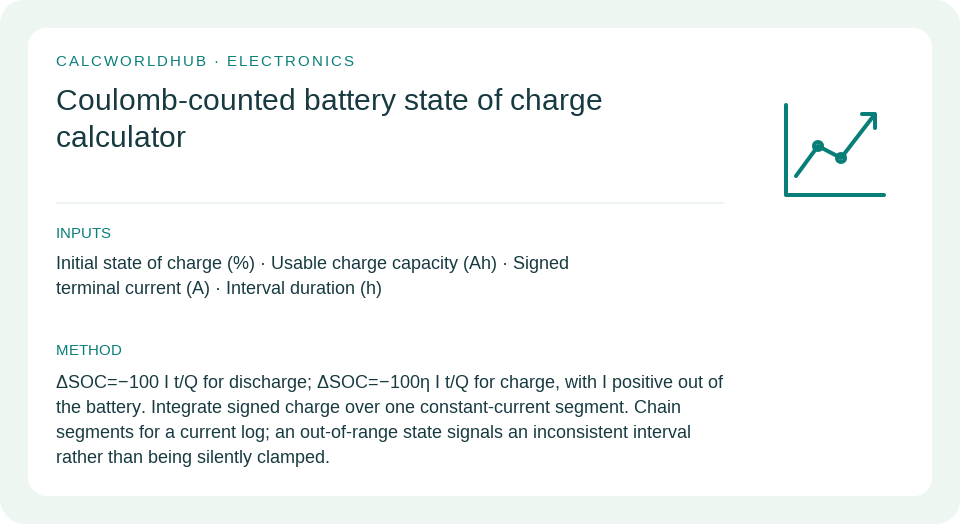
ΔSOC=−100 I t/Q for discharge; ΔSOC=−100η I t/Q for charge, with I positive out of the battery.
Integrate signed charge over one constant-current segment. Chain segments for a current log; an out-of-range state signals an inconsistent interval rather than being silently clamped.
A worked scenario
Initial state of charge (%) = 60; Usable charge capacity (Ah) = 100; Signed terminal current (A) = -10; Interval duration (h) = 2; Charge coulombic efficiency = 0.95.
- Final state of charge: 79 %
- Stored charge change: 19 Ah
- SOC change: 19 percentage points
Charging a 100 Ah battery from 60% at 10 A for two hours with 95% coulombic efficiency adds 19 Ah and reaches 79%.
Assumptions and edge cases
Requires a known initial SOC and usable capacity; no self-discharge, capacity aging, Peukert effect or voltage-based recalibration.
Reading the outputs
SOC change is in percentage points. Stored charge change is positive for charging and negative for discharge.
Frequently asked questions
Does coulombic efficiency equal energy efficiency?
No; charge efficiency compares ampere-hours, whereas energy efficiency also depends on voltage.
Why not clamp to 100% automatically?
Clamping hides a charging interval that extends beyond the model and discards the excess without explanation.
Will current-sensor offset accumulate?
Yes; even a small persistent offset makes SOC drift over time.
How do I use the Coulomb-counted battery state of charge calculator?
Enter Initial state of charge (%), Usable charge capacity (Ah), Signed terminal current (A), Interval duration (h), then complete the remaining labeled fields. Match the units shown beside each field and review the result together with the assumptions below.
What is a worked example of Coulomb-counted battery state of charge?
Initial state of charge (%) = 60; Usable charge capacity (Ah) = 100; Signed terminal current (A) = -10; Interval duration (h) = 2; Charge coulombic efficiency = 0.95. Final state of charge: 79 % Stored charge change: 19 Ah SOC change: 19 percentage points Charging a 100 Ah battery from 60% at 10 A for two hours with 95% coulombic efficiency adds 19 Ah and reaches 79%.
Read our calculation methodology.