How to use this calculator
Compare discharge charge capacity with charge capacity for the same battery cycle.
- Enter Charge capacity supplied (Ah), Discharge capacity returned (Ah). Match the units shown beside each field and review the result together with the assumptions below.
- Read the worked example below to check the expected input format and result.
- Compare another scenario by changing one input at a time. Use Reset to return to the starting values.
How this calculation works
Coulombic efficiency compares the charge returned during discharge with the charge supplied during the preceding charge step. Unlike energy round-trip efficiency, this capacity ratio does not weight charge by voltage.
Inputs and units
chargeCapacityAh— Charge capacity supplied (Ah)- Integrated capacity entering the cell during the charge step.
dischargeCapacityAh— Discharge capacity returned (Ah)- Integrated capacity leaving the cell during the matched discharge step.
Formula
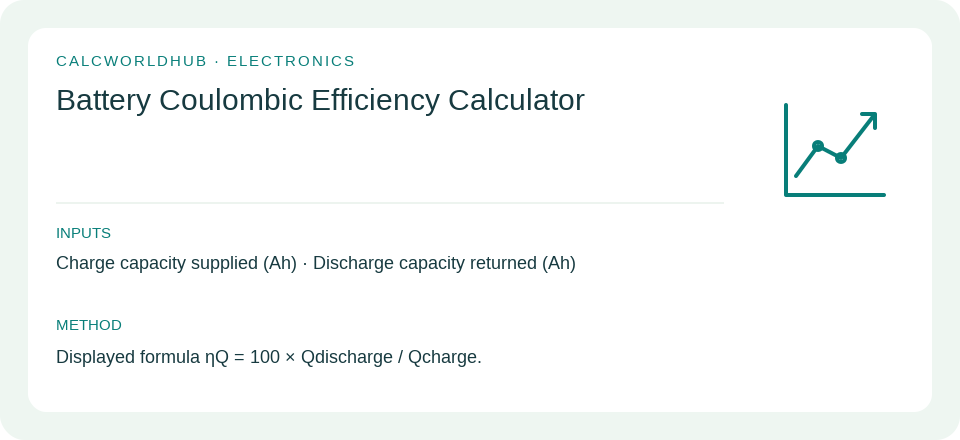
ηQ = 100 × Qdischarge / Qcharge.
Method
Enter charge and discharge capacity in the same units for one matched cycle. The calculator reports the returned-charge percentage and the capacity difference.
Worked example
A cycle that accepts 50 Ah and returns 47.5 Ah has coulombic efficiency 95% and 2.5 Ah of unreturned charge capacity.
Assumptions and limits
This ratio is meaningful only when capacities use the same current integration, cycle boundaries, temperature, and measurement convention. It is not voltage-weighted energy efficiency or a forecast of future battery life.
Frequently asked questions
How does this differ from round-trip efficiency?
Coulombic efficiency compares charge in ampere-hours; round-trip energy efficiency compares watt-hours and includes voltage differences.
Should I compare unrelated cycles?
Use charge and discharge capacity from the same cycle under the same test protocol.
Can the percentage exceed 100%?
For a matched closed cycle it should not; a larger discharge value usually signals mismatched boundaries, units, or measurement conditions.
How do I use the Battery Coulombic Efficiency Calculator?
Enter Charge capacity supplied (Ah), Discharge capacity returned (Ah). Match the units shown beside each field and review the result together with the assumptions below.
What is a worked example of Battery Coulombic Efficiency?
A cycle that accepts 50 Ah and returns 47.5 Ah has coulombic efficiency 95% and 2.5 Ah of unreturned charge capacity.
Reference: Natural Resources Canada definition of battery coulombic efficiency. See our calculation methodology.