How to use this calculator
Estimate battery state of health by comparing measured full-charge capacity with the battery’s rated capacity.
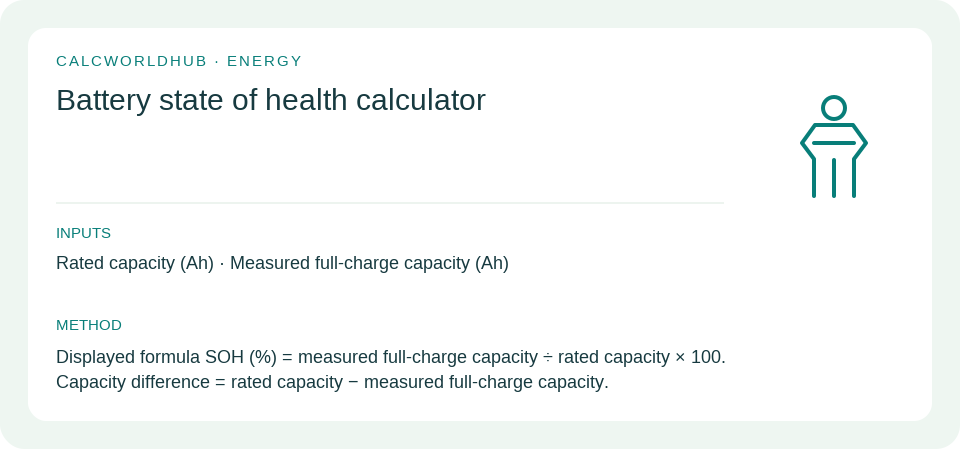
- Enter Rated capacity (Ah), Measured full-charge capacity (Ah). Match the units shown beside each field and review the result together with the assumptions below.
- Read the worked example below to check the expected input format and result.
- Compare another scenario by changing one input at a time. Use Reset to return to the starting values.
How this calculation works
State of charge describes energy currently stored, while state of health compares a battery’s measured maximum capacity with its original rated capacity. This capacity-retention estimate gives a simple percentage for tracking degradation when measurements are taken under comparable conditions.
Inputs and units
ratedCapacity— Rated capacity (Ah)- Original capacity rating from the battery data sheet, in amp-hours.
measuredCapacity— Measured full-charge capacity (Ah)- Capacity measured using a consistent, appropriate charge-discharge procedure and the same unit.
Formula
SOH (%) = measured full-charge capacity ÷ rated capacity × 100. Capacity difference = rated capacity − measured full-charge capacity.
Method
Enter the manufacturer-rated capacity and a measured full-charge capacity using the same unit, such as amp-hours. The ratio reports capacity retention relative to that rating; the difference shows the capacity shortfall or surplus in the same unit.
Worked example
If a battery rated at 100 Ah measures 82 Ah at full charge under the chosen test conditions, SOH = 82 ÷ 100 × 100 = 82%. The measured capacity is 18 Ah below the rating.
Assumptions and limits
Capacity is only one indicator of battery health. A proper capacity measurement depends on chemistry, temperature, discharge rate, cutoff voltage, rest periods, and test procedure. This estimate does not assess power capability, internal resistance, safety, remaining cycle life, or warranty eligibility.
Frequently asked questions
Is state of health the same as state of charge?
No. State of charge estimates energy currently available; this calculator compares measured maximum capacity with the original rating.
Can state of health exceed 100%?
Yes, a measurement can exceed the nameplate rating because of tolerances or test conditions. It does not prove that the battery is new or fully healthy.
Can I compare measurements taken at different temperatures?
Capacity tests are more comparable when temperature, discharge rate, cutoff voltage, and procedure are held consistent.
How do I use the Battery state of health calculator?
Enter Rated capacity (Ah), Measured full-charge capacity (Ah). Match the units shown beside each field and review the result together with the assumptions below.
What is a worked example of Battery state of health?
If a battery rated at 100 Ah measures 82 Ah at full charge under the chosen test conditions, SOH = 82 ÷ 100 × 100 = 82%. The measured capacity is 18 Ah below the rating.
Reference: BioLogic battery SOH capacity-retention method. See our calculation methodology.