How to use this calculator
Compare series polarity and short-circuit leakage measurements for two magnetically coupled windings.
- Enter First self-inductance (H), Second self-inductance (H), Magnetic coupling coefficient. Match the units shown beside each field and review the result together with the assumptions below.
- Read the worked example below to check the expected input format and result.
- Compare another scenario by changing one input at a time. Use Reset to return to the starting values.
Coupled-inductor aiding and opposing connection explained
Compare series-aiding and opposing inductance from the coil values and coupling coefficient, including short-circuit leakage inductance.
A numerical walkthrough
First self-inductance (H) = 0.001; Second self-inductance (H) = 0.004; Magnetic coupling coefficient = 0.95.
- Series-aiding inductance: 0.0088 H
- Series-opposing inductance: 0.0012 H
- First-winding short-circuit inductance: 0.000098 H
For 1 mH and 4 mH windings at k=0.95, the two series polarities differ greatly; the primary short-circuit measurement is far below its open-secondary inductance.
The model behind the numbers
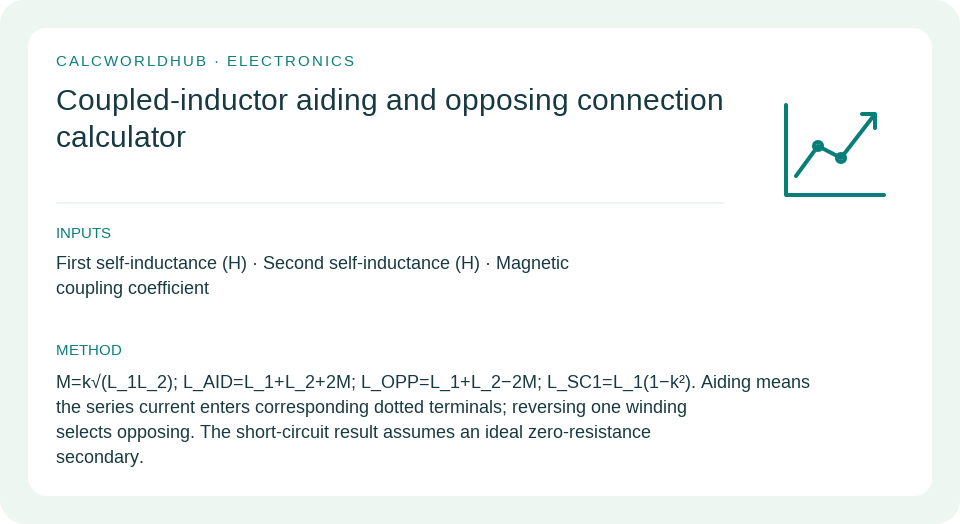
M=k√(L_1L_2); L_AID=L_1+L_2+2M; L_OPP=L_1+L_2−2M; L_SC1=L_1(1−k²).
Aiding means the series current enters corresponding dotted terminals; reversing one winding selects opposing. The short-circuit result assumes an ideal zero-resistance secondary.
What to enter
L1— First self-inductance (H)- Inductance of first winding with the other open.
L2— Second self-inductance (H)- Inductance of second winding with the other open.
k— Magnetic coupling coefficient- Magnitude between zero and one.
Interpreting the result
Linear reciprocal two-winding model without resistance, capacitance or saturation; AC measurement frequency must avoid self-resonance.
Reading the outputs
All outputs are inductances. Short-circuit inductance is referred to winding 1 and is not simply L1 minus mutual inductance.
Frequently asked questions
Can opposing inductance be negative?
Not for a passive valid coupling coefficient between zero and one.
Why is short-circuit inductance different from series opposing?
The secondary current adjusts freely under a short; series connection forces equal winding currents.
Does k=1 mean equal self-inductances?
No; unequal turns can give unequal self-inductances with perfect coupling.
How do I use the Coupled-inductor aiding and opposing connection calculator?
Enter First self-inductance (H), Second self-inductance (H), Magnetic coupling coefficient. Match the units shown beside each field and review the result together with the assumptions below.
What is a worked example of Coupled-inductor aiding and opposing connection?
First self-inductance (H) = 0.001; Second self-inductance (H) = 0.004; Magnetic coupling coefficient = 0.95. Series-aiding inductance: 0.0088 H Series-opposing inductance: 0.0012 H First-winding short-circuit inductance: 0.000098 H For 1 mH and 4 mH windings at k=0.95, the two series polarities differ greatly; the primary short-circuit measurement is far below its open-secondary inductance.
Read our calculation methodology.